Enterprise App Development in Australia — What Large Organisations Need to Know Before They Build?
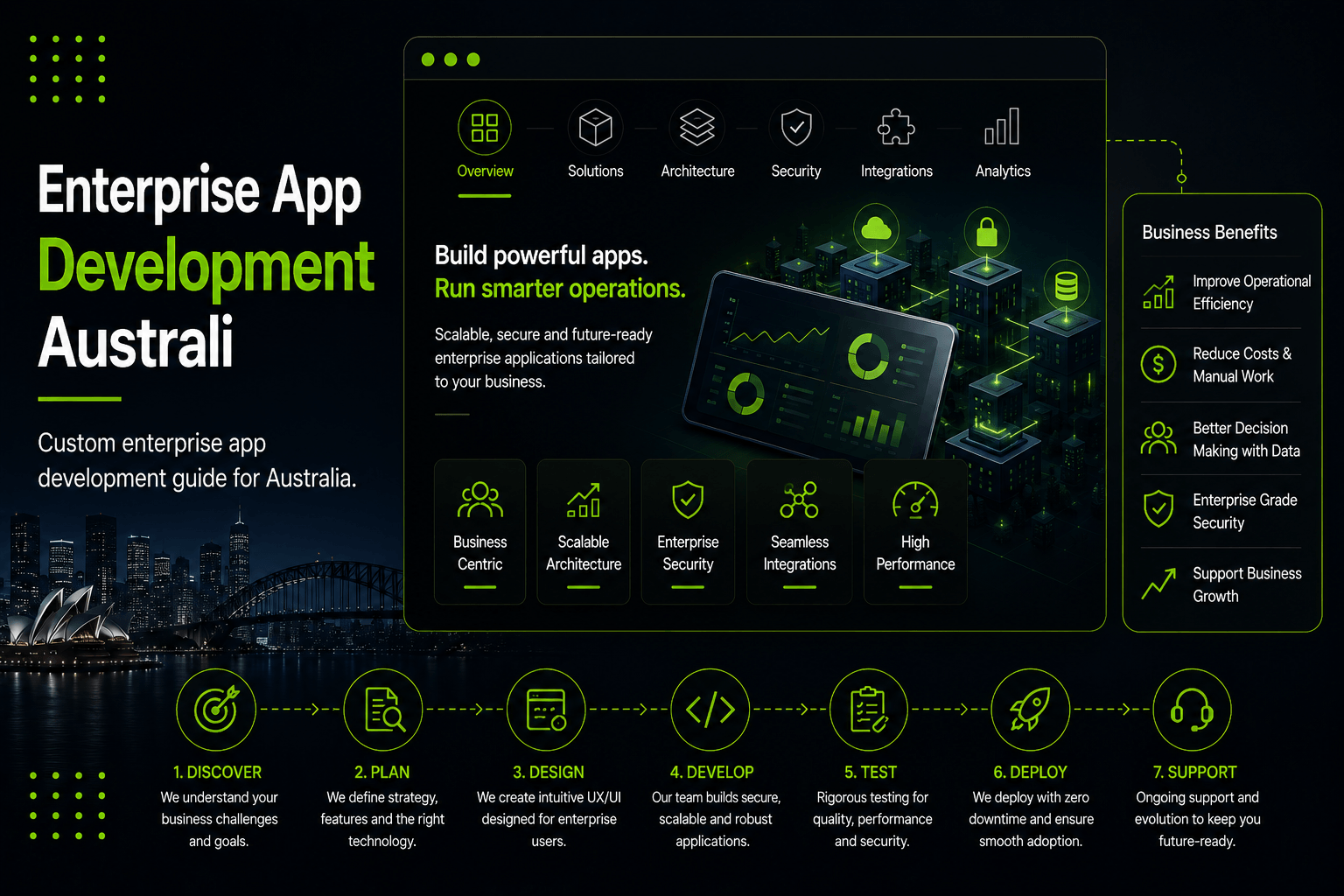
Building an app for a small business and building an app for a large organisation are not the same job.
The tools overlap. The process looks similar. But the requirements, the risks, and the consequences of failure are in a completely different league.
Enterprise app development in Australia is a specialised discipline. It demands architects who think in systems, developers who understand security at scale, and project managers who can coordinate complex stakeholders without losing momentum.
This guide is written specifically for IT managers, operations directors, digital transformation leads, and business owners at Australian organisations who are planning — or considering — a custom enterprise application.
What Is Enterprise App Development?
Enterprise app development is the process of building custom software applications for large organisations — applications that need to work reliably at scale, integrate with existing business systems, support large numbers of concurrent users, and meet strict security and compliance standards.
Enterprise apps are not glorified consumer apps. They are purpose-built tools that replace or enhance core business processes — things like:
- Internal workflow and approval systems
- Field service and operations management tools
- Customer portals and self-service platforms
- Inventory and supply chain management systems
- HR and employee management platforms
- CRM extensions and custom reporting dashboards
- Multi-location management tools
If your organisation is still running critical processes on spreadsheets, outdated legacy software, or disconnected tools that do not talk to each other — you are a candidate for enterprise app development.
Why Off-the-Shelf Software Often Fails Large Organisations?
The default recommendation for most businesses is to buy an existing SaaS solution before building something custom. For small businesses, that advice is usually right.
For large organisations, it frequently is not.
Here is why off-the-shelf software struggles at enterprise scale:
- Forced process changes — packaged software is built for the average customer. Your organisation is not average. Adopting software that does not match your workflows means either changing how your people work or accepting constant workarounds.
- Integration limits — enterprise environments have complex, often legacy systems. Off-the-shelf tools rarely integrate cleanly with everything you already run.
- Licensing costs at scale — per-seat SaaS pricing that looks reasonable at 50 users becomes eye-watering at 500 or 5,000.
- Security and compliance gaps — industries like healthcare, finance, and government have specific requirements that generic SaaS tools are not always equipped to meet.
- No competitive differentiation — if you and every competitor are running the same tool, the tool cannot be a source of competitive advantage.
- Custom enterprise app development solves all of these problems — at a higher upfront investment, but with far greater long-term returns.
The Core Technical Requirements of Enterprise Apps
What separates an enterprise app from a standard business app is not just size — it is architecture. Here is what enterprise-grade development actually involves:
Scalable Architecture
Enterprise apps must be designed to handle growth from day one. This means building on cloud infrastructure (AWS, Azure, or Google Cloud), using microservices or modular architecture that can scale individual components independently, and designing databases that perform under heavy load.
Robust Security
Enterprise security requirements go far beyond standard app development. You need:
- Role-based access control (RBAC) — different user types see different data and have different permissions
- End-to-end encryption for data in transit and at rest
- Multi-factor authentication (MFA)
- Detailed audit logging — who accessed what, when, and what they did
- Regular penetration testing and vulnerability assessments
- Compliance with Australian Privacy Act requirements and, where relevant, industry-specific standards (HIPAA for healthcare, PCI-DSS for payments, etc.)
Complex API Integrations
Enterprise organisations run multiple systems — ERP, CRM, HRIS, finance platforms, communication tools. Your new app needs to integrate with these cleanly through well-designed APIs, without creating fragile connections that break when upstream systems update.
Multi-User Access and Permissions
Enterprise apps routinely need to support hundreds or thousands of concurrent users across different roles, departments, locations, and even organisations. This requires careful data architecture, efficient database design, and thorough testing at scale.
Workflow Automation
One of the greatest ROI drivers of enterprise app development is automating manual, repetitive workflows. Approval chains, notifications, escalations, status updates, and reporting — all of these can be automated, removing bottlenecks and freeing your people for higher-value work.
How Much Does Enterprise App Development Cost in Australia?
Enterprise app development is a significant investment.
Here is a realistic framework:
- Mid-complexity enterprise app (internal tool, 50–200 users, standard integrations): $80,000 – $150,000 AUD
- Complex enterprise app (multi-department, hundreds of users, multiple integrations, custom reporting): $150,000 – $400,000 AUD
- Large-scale enterprise platform (thousands of users, real-time data, advanced security, compliance requirements): $400,000 AUD+
These figures assume an Australian development team. Offshore development costs less upfront but carries significant risks — communication friction, time zone delays, quality inconsistency, and difficulty maintaining the codebase long-term.
The correct way to think about enterprise app investment is not "how much does it cost" but "what is the cost of not building it." If your current manual processes cost $500,000 a year in staff time and errors, a $200,000 app that eliminates those costs pays for itself in under 18 months.
How Long Does Enterprise App Development Take?
Be realistic about timelines. Organisations that rush enterprise app development almost always regret it.
- Discovery and specification: 4 – 6 weeks
- UI/UX design: 3 – 5 weeks
- Development (sprints): 4 – 9 months
- Testing and QA: 4 – 6 weeks
- Deployment and training: 2 – 4 weeks
Total: 7 – 14 months for most enterprise projects
The discovery phase is especially critical for enterprise projects. Inadequate discovery is the single biggest cause of enterprise app failures. Invest the time to document requirements exhaustively before development begins.
5 Enterprise App Development Mistakes Australian Organisations Make
- Underestimating the discovery phase: Enterprise requirements are complex and involve multiple stakeholders with conflicting priorities. Rushing through discovery produces a specification that satisfies nobody and a product that solves the wrong problems.
- Not involving end users early: The people who will use the app every day know things that managers do not. Get frontline staff involved in requirement gathering and design reviews. The apps that get adopted are the ones built around how real people actually work.
- Building a monolith instead of a scalable system: Apps built as a single, tightly coupled codebase are difficult to update, expensive to scale, and fragile under load. Modern enterprise apps are built on modular, scalable architecture from the ground up.
- Ignoring change management: A great app that your team refuses to use is worthless. Plan for training, internal communication, and a rollout strategy before development completes — not after.
- No long-term support plan: Enterprise apps are not finished when they launch. Operating system updates, security patches, new feature requests, and growing user bases all require ongoing development investment. Budget for it from the start.
How to Choose an Enterprise App Development Company in Australia?
Enterprise app development is too important to hand to the wrong partner. Here is what to evaluate:
- Enterprise-specific experience — have they built apps at this scale before? Ask for case studies, not just consumer app portfolios.
- Security credentials — do they have a documented security development process? Can they speak to compliance requirements specific to your industry?
- Architecture expertise — can they explain their approach to scalability, API design, and system integration in plain language?
- Project governance — how do they manage a project of this complexity? What does their documentation, reporting, and change management process look like?
- Long-term partnership — enterprise apps evolve. You need a partner who will be there in year three, not just at launch.
- Australian-based team — for enterprise projects involving sensitive business data, having a local, legally accountable team is not optional.
Enterprise App Development With Ziff Digital
Ziff Digital builds custom enterprise app development solutions for Australian organisations that need scalable architecture, robust security, and complex system integrations — delivered by a dedicated Australian team.
We work with organisations across Sydney, Melbourne, Brisbane, Perth, and Adelaide, across industries including healthcare, professional services, construction, logistics, and financial services.