What Is GEO and Why Every Australian Business Needs It in 2026?
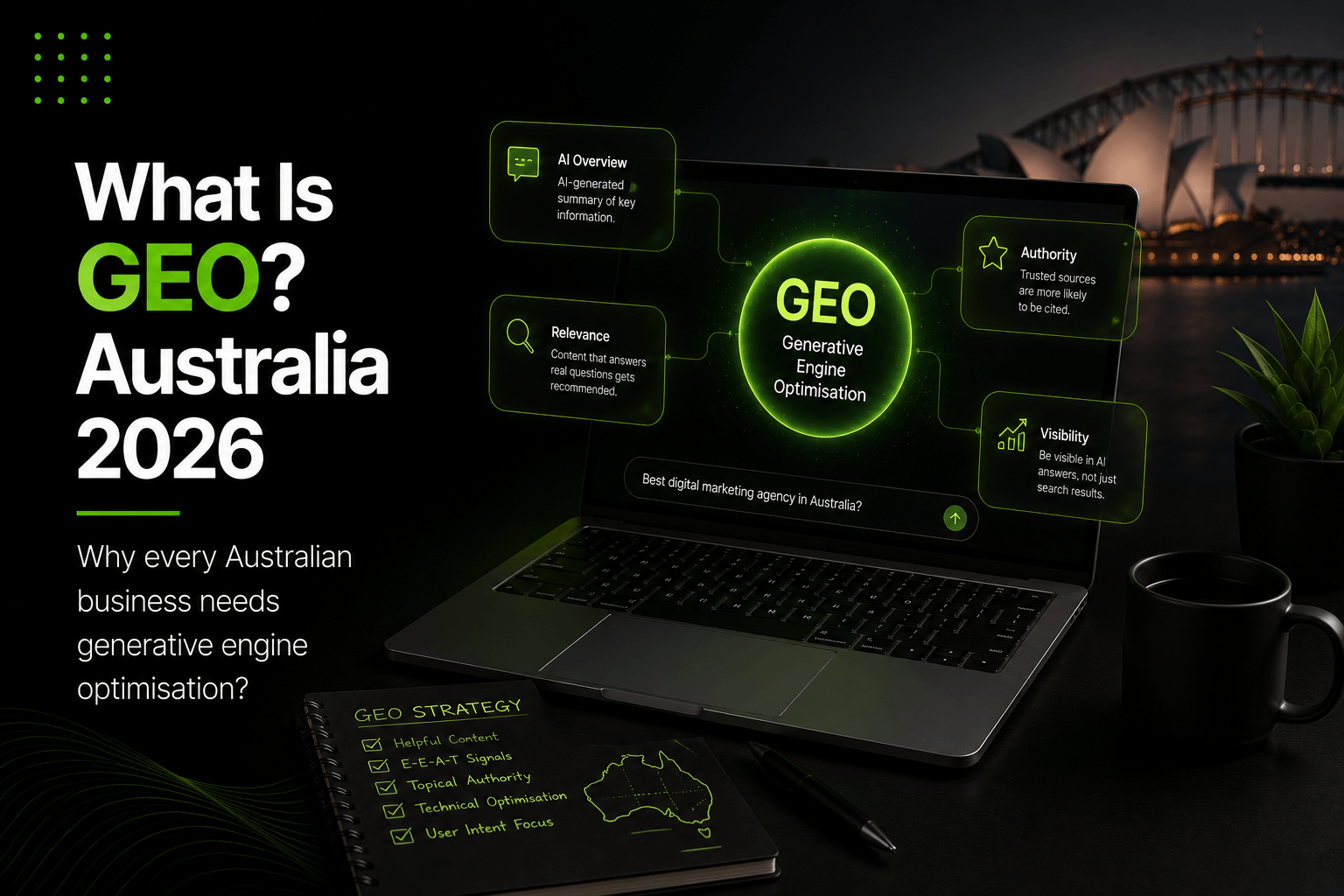
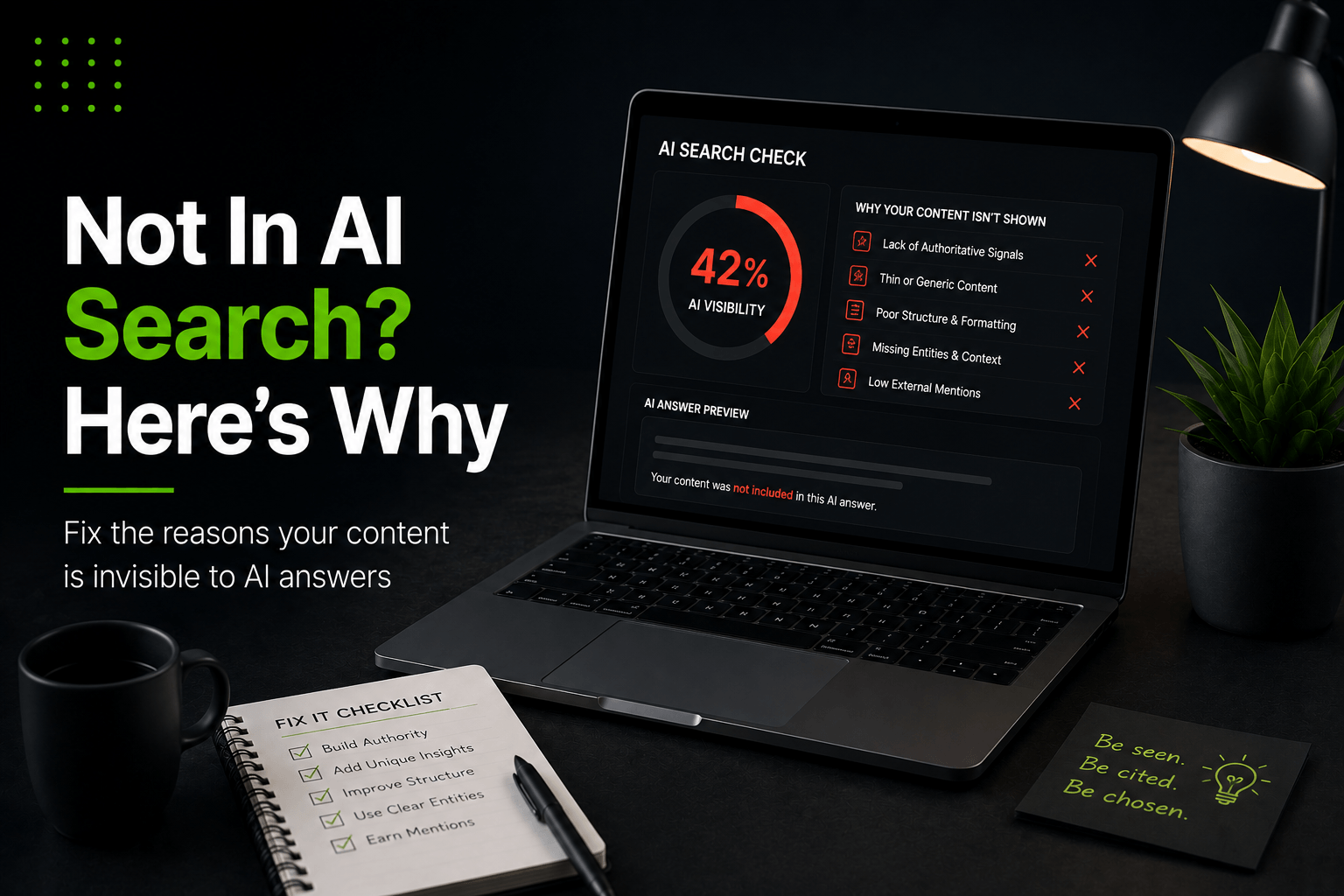
A potential customer opens ChatGPT and types: 'What is the best digital marketing agency in Sydney?' The AI generates an answer. It names three businesses, explains what each does, and recommends one. Your business is not mentioned - even though you are in Sydney, you offer exactly what this person needs, and you have been running Google Ads and doing SEO for years.
This is not a hypothetical scenario. It is happening right now, thousands of times a day, across Australia. And most Australian businesses have no idea it is costing them clients.
Generative Engine Optimisation - GEO - is the discipline that changes this. This guide explains exactly what GEO is, why it is different from SEO, and why 2026 is the year Australian businesses need to take it seriously.
What Is Generative Engine Optimisation (GEO)?
Generative Engine Optimisation is the process of structuring your digital content and online presence so that AI-powered search platforms - ChatGPT, Google AI Overviews, Perplexity, Gemini, and Claude - cite your brand when generating answers to user questions.
The term was coined in 2023 by researchers at Princeton, Georgia Tech, and the Allen Institute for AI. Their study, published at the KDD 2024 conference, tested optimisation strategies across 10,000 queries in 25 different subject areas. The core finding was clear: specific content strategies significantly increase the probability of being cited in AI-generated responses. This academic concept has since become a commercial priority for businesses in every industry.
📊 The Princeton GEO study found that content optimised with statistics, quotations and cited sources achieves up to 40% higher visibility in AI-generated responses (Aggarwal et al., KDD 2024).
Why AI Search Is Changing How Australians Find Businesses?
Australian buyers are changing the way they research and make purchasing decisions - faster than most businesses realise.
📊 AI Overviews now appear on a large and growing share of Google searches, and Australian businesses are seeing more queries answered on the results page rather than on their site.
This means nearly half of all Google searches in Australia are now showing an AI-generated answer at the top of the page - before any traditional blue links appear. Users read the AI answer, get what they need, and often never scroll to the organic results below. For businesses that worked hard to rank on page one of Google, this is a seismic shift.
And it is not just Google. ChatGPT handles hundreds of millions of queries globally. Perplexity AI is growing rapidly in Australia. Gemini is integrated into Google Workspace and Android devices used by millions of Australians daily. The way people search for products, services, and professional expertise is fundamentally changing.
GEO vs SEO: What Is the Difference?
The most common question Australian business owners ask when they first encounter GEO is whether it replaces SEO. The honest answer is no - but it is a critical addition to it.

GEO vs SEO: What Is the Difference?
📊 Only 12% of URLs cited by AI search engines rank in Google's top 10 for the same prompt (Ahrefs, 2026). SEO ranking does not predict AI citation. The two disciplines need to run in parallel.
This data point is the most important thing Australian businesses need to understand about GEO. You can rank first on Google for a keyword and still be invisible in AI-generated answers for the same topic. Your SEO work and your GEO work are solving different problems for different channels.
How AI Search Platforms Decide Who to Cite?
Understanding how AI systems choose which sources to reference is the foundation of any GEO strategy. Each platform has slightly different mechanisms, but they share common evaluation criteria.
Topical Authority
AI models evaluate how comprehensively and consistently your brand covers a subject area. A website with 50 well-structured, deeply informative articles about a specific topic is significantly more likely to be cited than a website with 200 thin, keyword-stuffed pages. Authority is built through consistent, expert-level content published over time.
Content Structure and Extractability
AI systems are looking for content they can easily extract and synthesise. This means short paragraphs, direct answers at the start of each section, clear heading hierarchies, structured lists, and FAQ content that directly answers common questions. Content buried under paragraphs of preamble is less likely to be extracted and cited.
Brand Entity Recognition
AI models have knowledge about brands - what they do, where they operate, how they are described across the web. If your business is poorly represented in third-party sources, review sites, industry directories, and news mentions, AI systems may not recognise it as a credible entity. Entity building - ensuring AI models know who you are - is a core component of GEO.
External Citations and Authority Signals
Just as traditional SEO values backlinks from trusted websites, GEO values citations and mentions from authoritative third-party sources. Being mentioned in industry publications, featured in news articles, reviewed on reputable platforms, and listed in professional directories all contribute to the authority signals AI models use to evaluate credibility.
What GEO Looks Like in Practice?
Many Australian business owners want a concrete picture of what GEO activity actually involves. Here are the core tactics a specialist GEO agency would implement for your business.
AI Prompt and Query Analysis
Before creating or restructuring content, a GEO specialist analyses how your target customers are querying AI platforms. This is different from traditional keyword research - it maps the conversational questions, multi-part queries, and decision-stage prompts that real users type into ChatGPT and Perplexity when looking for businesses like yours. The output is a list of specific content opportunities your brand should own.
Content Restructuring for AI Readability
Existing website content is restructured to be clearly interpretable by AI systems. This typically involves shortening paragraphs, adding direct answers at the top of sections, implementing structured FAQ content, improving heading hierarchy, adding statistics and citations to claims, and creating AI-friendly content summaries. This work often produces faster GEO results than creating new content because Google and AI systems already know and index the pages.
Entity Optimisation
Your brand's digital footprint is audited and strengthened across third-party platforms - Google Business Profile, industry directories, LinkedIn, review sites, media mentions, and professional associations. The goal is to ensure every major AI system has consistent, clear, and authoritative information about who your business is and what it does.
Technical GEO
Technical factors affect AI crawlability. Schema markup helps AI systems understand your content structure. Checking that AI bots are not blocked by your robots.txt file is essential - many Australian websites accidentally block AI crawlers through Cloudflare configurations. Page speed, mobile performance, and structured data implementation all contribute to GEO performance.
Why 2026 Is the Year to Start?
GEO is still early enough that most Australian businesses have not started - which means there is a genuine first-mover advantage available right now. The research from Digital Agency Network confirms this clearly: by early 2026, most enterprise marketing teams have a GEO initiative underway, while most SMB marketing teams have not started yet.
The businesses that build AI citation authority in 2026 will be the businesses that AI systems default to citing in 2027, 2028, and beyond. Citation authority, like domain authority before it, compounds over time. The brands that start building it now will have a structural advantage that becomes increasingly difficult for later entrants to close.
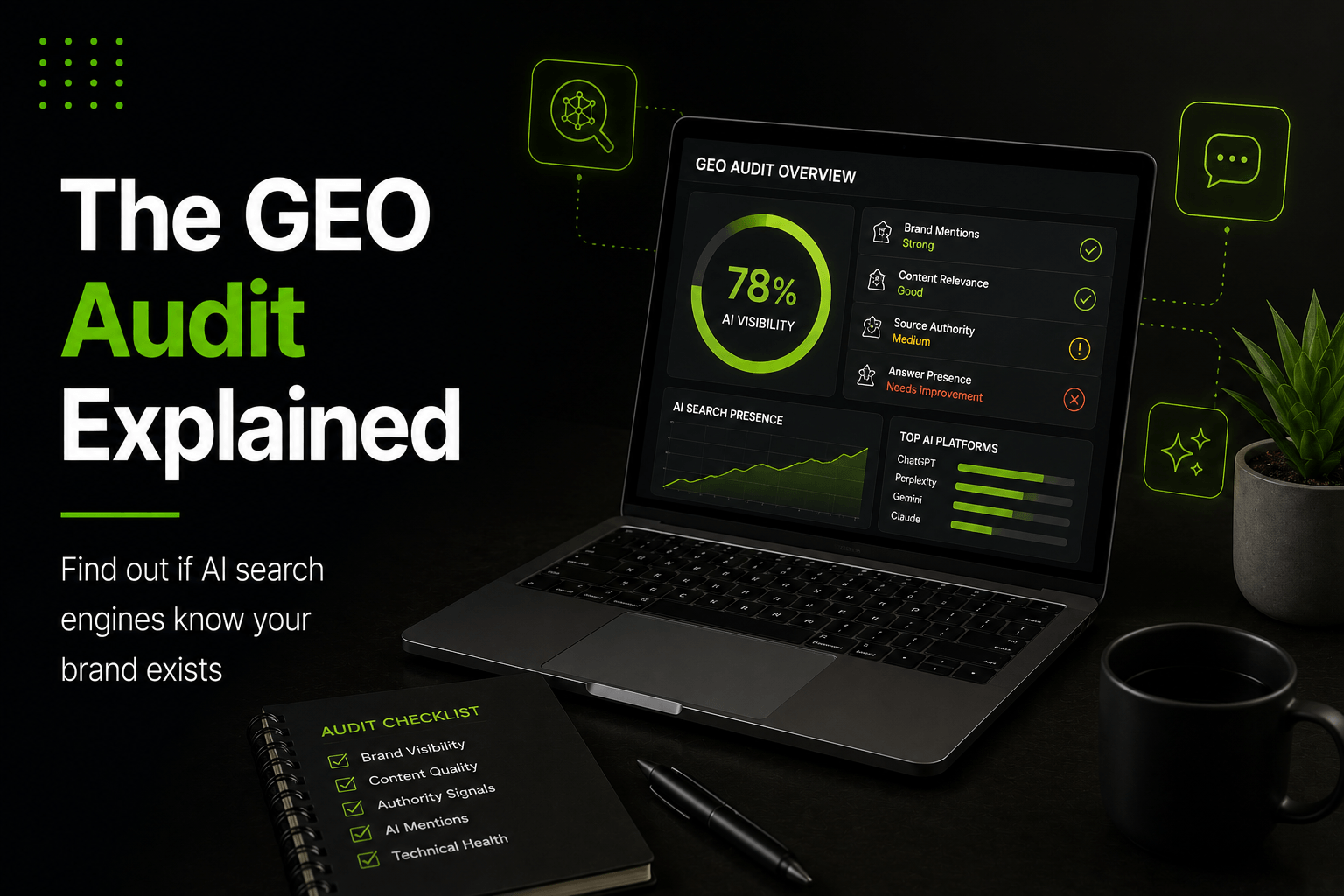
💡 The single most valuable action an Australian business can take today is a GEO audit - checking how ChatGPT, Perplexity, and Google AI Overviews currently describe your business when asked about your category. What you find will tell you exactly how much work needs to be done.
Which Australian Businesses Need GEO Most Urgently?
While every Australian business that depends on digital visibility benefits from GEO, some categories face the most immediate risk from AI search displacement.
- Professional services - lawyers, accountants, financial advisers, consultants - where clients research providers through AI before shortlisting
- Healthcare and medical services - where patients ask AI for clinic, specialist, and treatment recommendations
- Home services - plumbers, electricians, builders - where people increasingly ask AI 'who is the best [trade] near me'
- Digital agencies and technology businesses - where buyers evaluate providers through AI research before making contact
- E-commerce - where product recommendations are increasingly AI-mediated
- Real estate - where buyers and sellers research agents and suburbs through AI tools
Frequently Asked Questions
Is GEO the same as SEO?
No. SEO optimises your website to rank in traditional search engine results like Google's blue links. GEO optimises your content and authority signals to be cited in AI-generated answers across ChatGPT, Google AI Overviews, Gemini, and Perplexity. Approximately 80 percent of the underlying tactics overlap - quality content, strong authority, technical foundations - but GEO requires specific structuring, entity building, and AI-focused optimisation that traditional SEO does not address.
How quickly can GEO produce results for my Australian business?
Well-executed GEO optimisation can produce measurable improvements in AI citation rates within 4 to 8 weeks - significantly faster than traditional SEO. Content restructuring of existing pages, FAQ additions, and entity building can start showing citation improvements quickly because AI systems continuously re-evaluate sources. Building deep topical authority and consistent AI citations takes 3 to 6 months of sustained effort.
Do I need to choose between SEO and GEO?
No. The most effective digital marketing strategy in 2026 combines both. SEO drives traffic through traditional Google search - which still handles the majority of search volume. GEO builds brand presence in AI-generated answers - the fastest-growing search channel. Both share technical and content foundations, and the investment in one supports the other. Treating them as competing priorities misunderstands how search is evolving.
How do I know if my business is currently being cited in AI search?
The simplest starting point is a manual audit - open ChatGPT, Perplexity, and Google AI Overviews and ask questions in your category. 'What are the best digital marketing agencies in Melbourne?' 'Who are the top personal injury lawyers in Sydney?' 'Which is the best plumber in Brisbane?' If your business does not appear in these answers, you have a GEO gap. A professional GEO audit provides a systematic, comprehensive measurement of your AI citation performance across all major platforms.
Ready to find out how your Australian business appears in AI search results? Ziff Digital offers free GEO audits for Australian businesses - book yours today.