Your Competitors Are Already Using AI in Their Marketing - Are You Being Left Behind?
Two years ago, using AI in your marketing made you an early adopter. You were ahead of the curve, getting an edge over businesses still doing everything manually. Today, the situation has completely reversed.
In 2026, the large majority of marketers globally use AI tools in their daily work - a share that has climbed steeply in only a couple of years. The shift has been faster and more complete than almost anyone predicted. For Australian businesses that have not yet made AI a core part of their marketing operation, the gap between them and their competitors is not just visible - it is growing wider every single month.
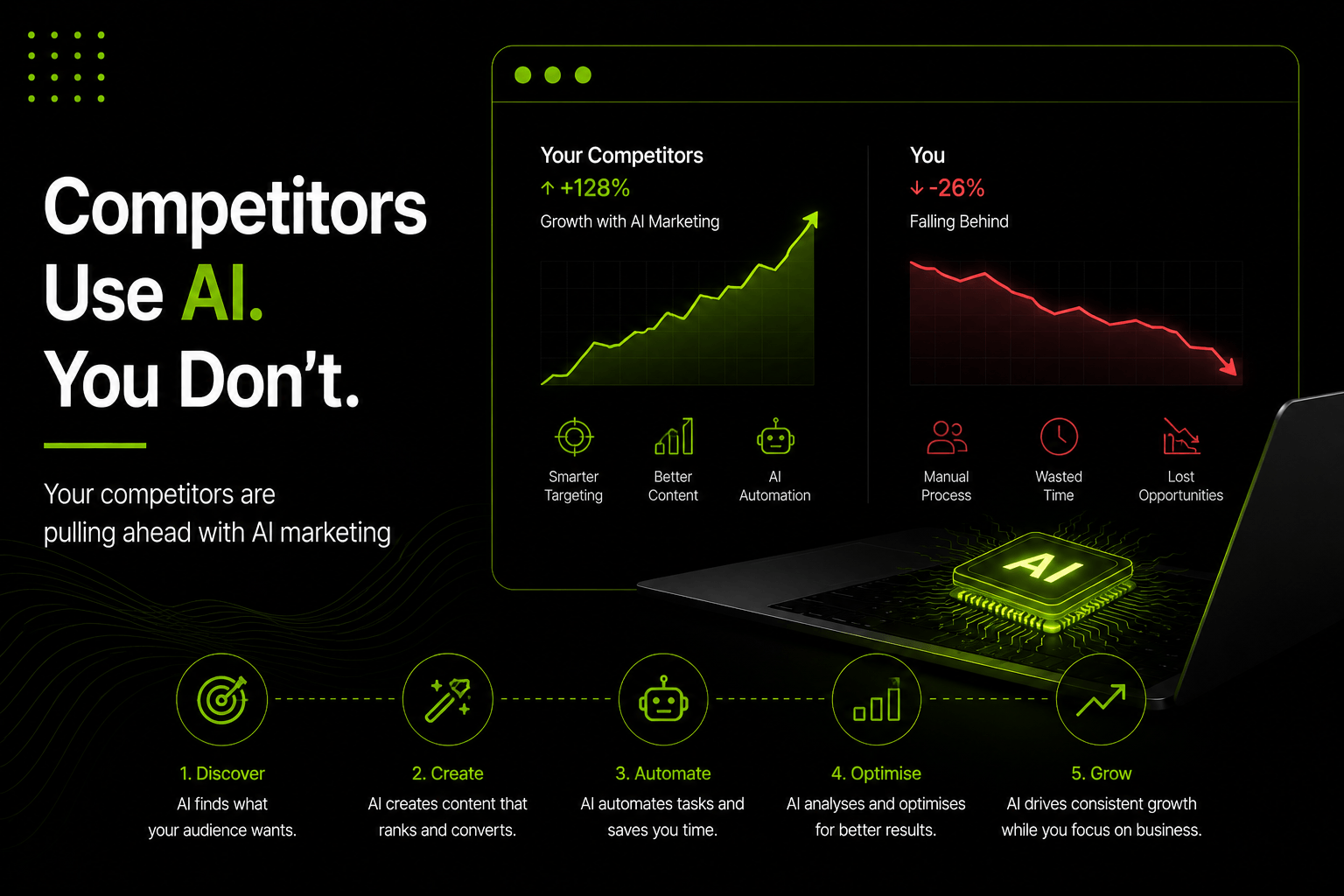
This is not about following trends for its own sake. It is about something very practical. Your competitors using AI can produce more content, target more precisely, respond faster, personalise better, and learn from data more quickly than you can with traditional methods. Over time, those advantages compound into a durable competitive gap that becomes increasingly difficult to close.
The Scale of What Has Already Shifted
- 80% of marketers now use AI for content creation - up from 35% two years ago
- 75% of marketers use AI for media production
- Marketing teams using AI report meaningful productivity gains
- AI-powered teams generate 35% more qualified leads than non-AI teams
- 94% of B2B marketers plan to use AI for content creation going forward
- 83% of growing Australian SMBs have already adopted AI marketing systems
For Australian businesses, the local market context matters. The Australian AI market is growing quickly. Businesses using AI marketing tools across Sydney, Melbourne, Perth, Brisbane, and Adelaide are producing more content, appearing in more searches, responding to more leads, and retaining more clients - not because they have bigger teams, but because AI allows smaller teams to operate at a level that previously required far greater resources.
What Your Competitors Are Actually Doing With AI Right Now?
Content Creation at Scale
AI tools are being used to research, outline, draft, and refine blog posts, social media content, email newsletters, ad copy, and website landing pages. A marketing team that used to produce four blog posts a month can now produce sixteen - at the same or higher quality - with the same headcount.
This matters enormously for SEO. Businesses that publish sixteen or more blog posts per month generate four and a half times more leads than those that publish infrequently. The businesses using AI content tools are not just saving time - they are building SEO authority at a speed that manual-only teams simply cannot match.
SEO Research and Optimisation
AI-powered SEO tools analyse competitor content, identify keyword gaps, suggest content structures that align with what Google is currently rewarding, and generate on-page optimisation recommendations in minutes rather than hours. Businesses using these tools are finding and capturing search opportunities that their manually-operated competitors are completely missing.
What AI SEO Tools Do That Takes Humans Hours Manually?
- Analyse the top-ranking pages for any keyword and identify exactly why they rank
- Generate comprehensive keyword clusters from a single seed term
- Identify content gaps between your website and your competitors' websites
- Produce optimised meta titles, descriptions, and heading structures
- Flag technical SEO issues across hundreds of pages simultaneously
Personalisation at Scale
AI tools allow businesses to send emails personalised to the specific behaviour and interests of each recipient, show website visitors content relevant to how they arrived and what they have previously engaged with, and deliver advertising to micro-audiences defined by intent signals rather than broad demographic categories.
This level of personalisation used to require enterprise technology budgets. In 2026, it is accessible to businesses of almost any size - and the Australian businesses using it are building client relationships that generic, broadcast-style marketing simply cannot replicate.
Lead Qualification and Follow-Up Automation
AI tools can score incoming leads based on their likelihood to convert, send personalised follow-up sequences triggered by specific actions, and identify which prospects in your pipeline are most likely to need attention right now. The result is sales teams spending their time on the highest-value conversations rather than manually sifting through every enquiry.
The Specific Risk of Waiting - Why This Matters More Than You Think?
The advantage that AI provides is not static. It compounds over time in ways that make the cost of waiting significantly higher than most businesses realise.
The Content Compounding Problem
A competitor who has been using AI content tools for twelve months has not just produced more content than you. They have produced content that has been indexed by Google, built topical authority, earned backlinks, been shared, and is now generating consistent organic traffic every single day. The gap between your content library and theirs is not twelve months of blog posts. It is twelve months of compounding SEO authority that continues to grow every day.
The Data Compounding Problem
A competitor who has been using AI-powered email personalisation for twelve months has not just sent more emails. They have a twelve-month library of data about what subject lines their audience opens, what content converts, and what offers their clients respond to. Their email marketing gets more effective over time. Yours starts from zero.
The Compounding Gap in Numbers
- SEO-focused content has averaged around 702% ROI over three years in First Page Sage's analysis of its own client campaigns - an agency benchmark rather than independent research
- Businesses executing consistent content strategies for 12+ months see 200-400% organic traffic increases
- A single blog post written today can generate free traffic for 3.5 years
- Every month of delay is a month of compounding advantage going to your competitors
What AI Cannot Do - And Why This Distinction Matters?
It would be misleading to suggest that AI marketing tools solve everything or that any business can hand their marketing to an AI and walk away. The data reveals an important nuance here that separates businesses winning with AI from those wasting their budget on it.
Many marketers report already seeing AI outputs that resemble content from competitors. The risk of AI homogenisation - everyone producing similar-sounding content because they are all using the same tools with similar prompts - is real and growing.
The Businesses Winning With AI Share These Characteristics
- They use AI for the mechanical, repetitive parts of marketing - research, first drafts, formatting, scheduling
- They keep genuine human creativity, brand voice, and strategic judgment at the centre of everything
- They continuously train their AI tools with their specific brand guidelines and tone
- They measure results rigorously and adjust their AI workflows based on what the data shows
- They treat AI as an amplifier of human capability - not a replacement for thinking
The Tools Making the Biggest Difference Right Now
For Content Creation and SEO
Tools like ChatGPT, Claude, Jasper, and Surfer SEO are producing real results for Australian marketing teams. They are not replacing human creativity - they are removing the time-consuming research, drafting, and formatting work so human energy can focus on strategy, voice, and quality control.
For Marketing Automation and Personalisation
HubSpot's AI features, Klaviyo for email marketing, and various AI-powered CRM tools are helping Australian businesses deliver experiences that feel personal at a scale impossible without automation. The businesses already running these tools are building client relationships that manual processes simply cannot replicate at speed.
For Social Media Management
AI tools are helping teams generate content ideas, repurpose existing content across multiple formats and platforms, schedule posts at optimum engagement times, and analyse which content performs best - all without the hours of manual work that previously made consistent social media management so resource-intensive.
Where to Start if You Are Behind?
The best starting point is to pick one specific marketing function where you are currently capacity-constrained and find one AI tool that addresses exactly that problem. If content creation is the bottleneck, start there. If lead follow-up is falling through the cracks, start there. If your social media is inconsistent because it takes too much time, start there.
Do not try to adopt twelve tools simultaneously. Master one. Measure the difference it makes over sixty days. Then build from there with confidence. What is no longer a reasonable option - given where the market has moved - is to wait until you feel completely ready.
Most of your competitors are already using these tools. The ones who are ahead did not wait for perfect conditions. They started, learned quickly, and built momentum. The best time to do the same is now.