Your Website Has Traffic But No Leads. Here's Exactly What Is Killing Your Conversions.
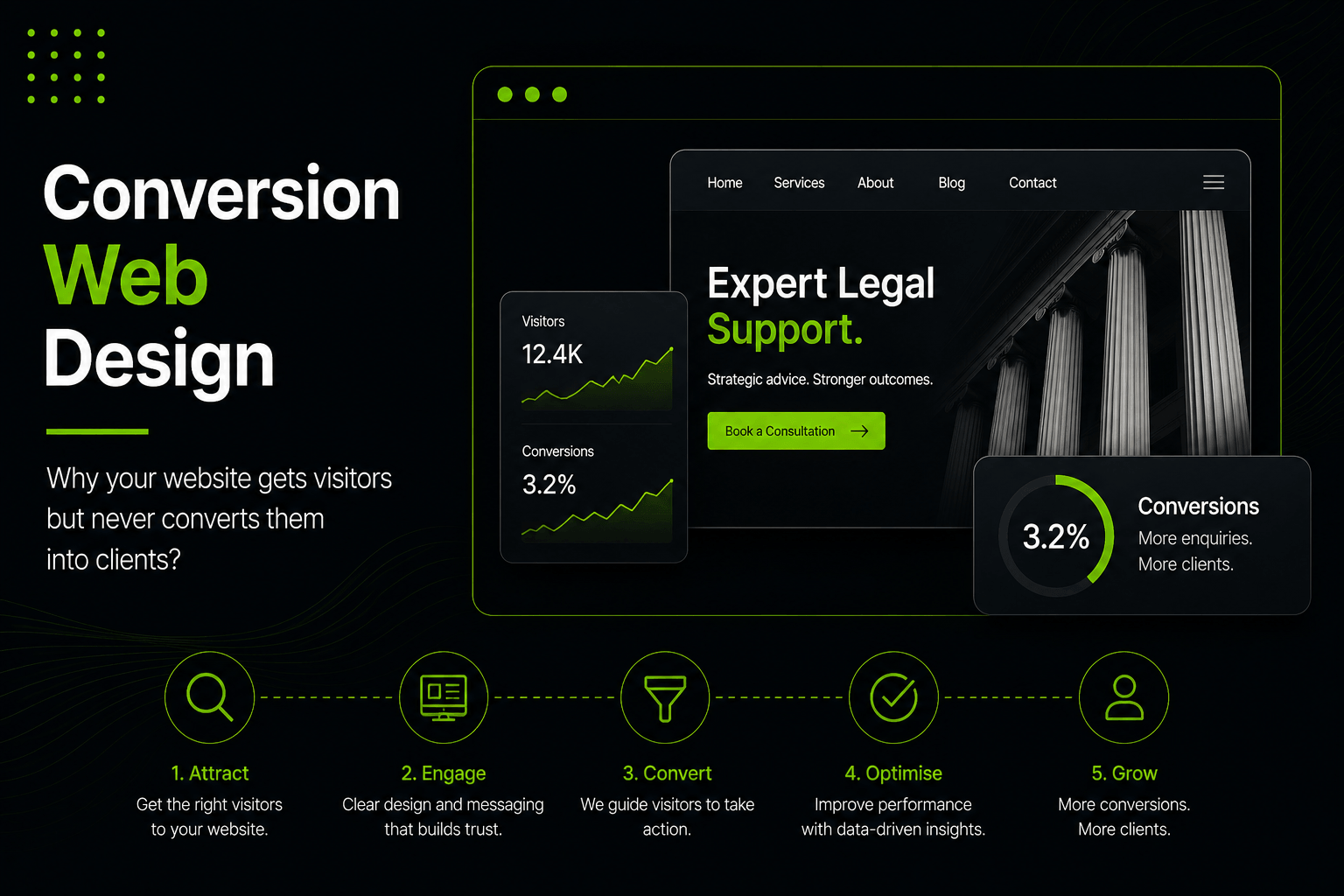
Traffic Without Conversions Is Just an Expensive Number
Most business owners celebrate when they see their website traffic going up. And more traffic is good - but only if it is converting into actual enquiries, calls, form submissions, or sales. A website that attracts five hundred visitors a month and converts none of them is not a successful website. It is just an expensive business card.
Conversion-focused web design is the discipline of building websites that do not just attract traffic but actively turn visitors into customers. It combines psychology, UX design, visual design, copywriting, and technical performance to create an experience so frictionless and compelling that visitors naturally move toward taking action.
In Australia's competitive digital landscape, the difference between a website that converts at two percent and one that converts at six percent is the difference between struggling to grow and building a client pipeline that consistently fills. This is one of the most impactful improvements any business can make to its digital presence, and it requires far less time than most people expect.
The Five Reasons Your Website Is Not Converting
After working with dozens of Australian businesses across Sydney, Melbourne, Perth, Brisbane, and Adelaide, the same conversion problems appear over and over. Here is what they are and why they matter.
Reason One: Your Value Proposition Is Not Clear Immediately
A visitor to your website has a very simple question the moment they land on your page: is this the right place for me? If they cannot answer that question within five seconds, they leave. Most websites make this far too difficult.
Your homepage - and ideally every key landing page - needs to communicate in simple, direct language exactly what you do, who you do it for, and why your business is the right choice. Not through a clever tagline. Not through jargon. Through a clear, specific statement that speaks directly to the person you most want to work with.
"We help Australian law firms get more clients from Google" is a value proposition. "Digital excellence for growth-focused businesses" is not. Specificity builds trust. Vagueness creates doubt.
Reason Two: Your Calls to Action Are Buried or Weak
A call to action (CTA) is the specific thing you want a visitor to do next. "Book a free consultation", "get a quote", "start your project" - these are calls to action. If your website does not have clear, prominent calls to action on every key page, you are making your visitors do work they should not have to do to get in contact with you.
The most common CTA mistakes are having a single CTA buried at the bottom of the page, using vague CTA text like "click here" or "learn more", using a colour for the CTA button that blends into the background rather than standing out, and not having a CTA visible without scrolling on desktop and mobile. Each of these is fixable in hours and can produce an immediate improvement in conversion rate.
Reason Three: Your Page Speed Is Costing You More Than You Realise
Every additional second your website takes to load loses you a measurable percentage of visitors. The effect is consistently larger on mobile than on desktop. With mobile accounting for a large share of Australian web traffic, a slow website is a conversion killer that most business owners have never checked.
The good news is that page speed improvements have become one of the most tractable technical fixes in web development. Optimising images, implementing caching, minimising render-blocking scripts, and upgrading to faster hosting are all achievable relatively quickly and deliver both conversion and SEO benefits simultaneously.
Our web development team builds websites to pass Google's Core Web Vitals benchmarks as standard, ensuring your site is fast, stable, and smooth on every device.
Reason Four: Your Social Proof Is Not Working Hard Enough
Before almost any Australian business buyer or consumer makes a significant purchasing decision, they look for evidence that others have made the same choice and been happy with it. This is social proof, and it is one of the most powerful conversion drivers available to any business.
Social proof on a website takes many forms - client testimonials, case studies, review ratings, logos of recognisable clients, number of clients served, awards and accreditations. The businesses that place this evidence prominently and specifically - not buried on a testimonials page but integrated throughout every key page of the website - consistently convert at higher rates than those that do not.
The key word is specific. "Great service, highly recommend" is weak social proof. A testimonial that describes a specific problem, the specific solution your business provided, and a specific outcome achieved is powerful social proof that speaks directly to potential clients facing a similar situation.
Reason Five: Your Website Is Designed for Aesthetics, Not Psychology
Beautiful websites that do not convert are one of the most common outcomes of working with designers who prioritise visual appeal over conversion psychology. A website can be visually stunning and commercially useless at the same time.
Conversion-focused web design applies principles of cognitive psychology to every design decision. Where is the human eye drawn first on a page? How does colour influence emotional response and action? What visual hierarchy guides a visitor from first impression to contact? How does the choice of photography or illustration affect perceived trustworthiness?
These questions should be driving every design decision your website makes. When they do, the result is a website that feels as good as it looks and performs measurably better in every conversion metric that matters.
The UX Design Principles That Drive Conversions
User experience (UX) design and conversion rate optimisation are deeply connected. Every UX decision that makes your website easier, faster, and more intuitive to use also increases the likelihood that a visitor takes the action you want them to take.
The most conversion-critical UX principles for Australian business websites are navigation clarity - can a visitor find what they need in three clicks or fewer - form simplicity, mobile-first design, visual hierarchy, and consistent action prompts throughout the user journey.
Our UX design services are built around these principles from the ground up. We do not design for awards or portfolio screenshots. We design for the specific behaviour you want your visitors to take.
How Branding and Conversion Design Work Together?
A website that converts is not just technically well-built. It also creates a feeling of trust and professionalism that makes potential clients confident in reaching out. This is where brand identity intersects with conversion design.
Colour psychology, typography choices, imagery style, and visual consistency all contribute to the subconscious assessment a visitor makes about whether your business is credible, professional, and worth their time. A website with inconsistent or amateurish visual design signals uncertainty. A website with a strong, coherent visual identity signals confidence and expertise.
This is why the businesses that invest in professional branding services as part of their web design project consistently outperform those that treat branding as an afterthought. The two are inseparable.
The Conversion-SEO Connection: Why They Must Be Built Together?
One of the most important things to understand about conversion-focused web design is that it is also SEO-friendly web design. The same factors that improve conversion rates - page speed, mobile performance, clear content structure, strong internal linking, reduced bounce rates, longer session durations - are also signals that Google uses to determine rankings.
A website that converts well sends positive behavioural signals to Google. Visitors spend more time on the site, engage with more pages, and return more often. Google interprets these signals as evidence that the website is genuinely useful to its visitors, and rewards it with higher rankings. Higher rankings bring more traffic. More traffic, combined with strong conversion design, brings more clients.
This virtuous cycle is why the most effective approach is to build SEO and conversion design together from the start rather than as separate projects. At Ziff Digital, every website we build is designed to rank and designed to convert - because one without the other is only half the result.
Ready to Turn Your Website Into Your Best Sales Tool?
If your website is attracting visitors but not converting them into clients, you do not necessarily need more traffic. You need a better-converting website. The most cost-effective step you can take right now is a conversion audit - an honest assessment of what is preventing visitors from taking action and what specific changes will make the biggest difference.
Talk to Ziff Digital today about a conversion-focused redesign or optimisation of your existing website. Our web design and web development teams work with Australian businesses across every industry to build websites that are fast, beautiful, and built to convert every visitor into an opportunity.