7 Signs You Need to Rebuild Your Website (Not Just Redesign It)
There is a decision that every Australian business eventually faces: what do we do with the website?
It looks a bit tired. Maybe it loads slowly. Maybe it is hard to update. Maybe it is just not converting the way it should. The tempting response is a redesign — give it a facelift, update the colours, swap out the photos, maybe add a new page or two. Fresh, modern, done.
The problem is that redesigning a structurally broken website is like painting over cracks in a wall. It looks better for a while. But the underlying problem is still there, and it will surface again — usually at the worst possible time.
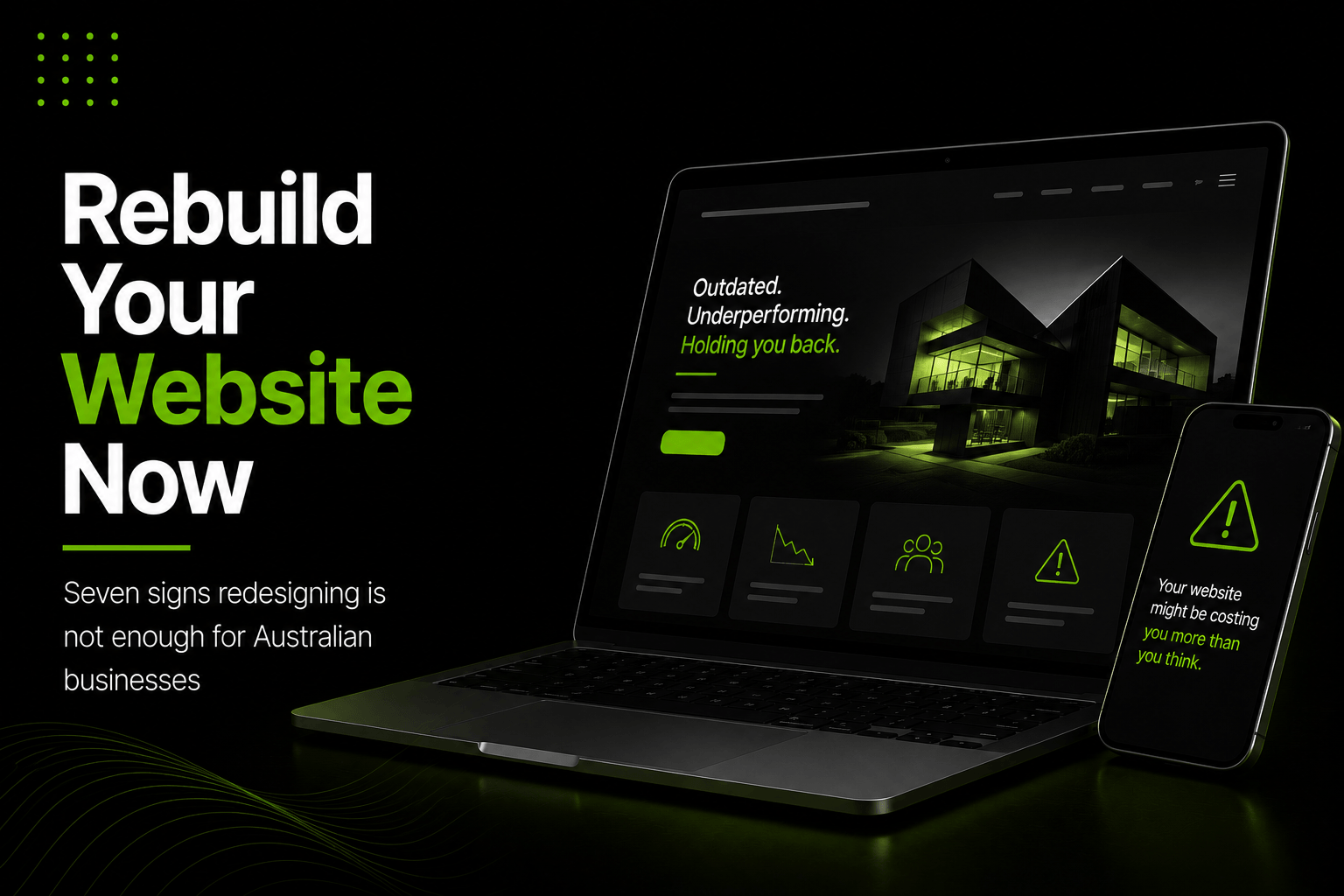
This guide helps you tell the difference. If your website has any of these seven signs, a redesign will not solve your problem. You need a rebuild.
Redesign vs Rebuild: What's the Actual Difference?
Before diving into the signs, let us be clear about what each option actually means.
A website redesign updates the visual appearance and user experience of your existing site. It typically involves new graphic design, updated copywriting, improved navigation, and some UX improvements — but the underlying technology, code structure, CMS, and architecture stay the same. A redesign is the right call when the foundation is solid but the surface needs work.
A website rebuild starts from scratch. New technology stack, new code structure, new architecture, potentially a new CMS. The content and brand direction carry over, but everything underneath is rebuilt. A rebuild is the right call when the foundation itself is the problem.
The most common mistake Australian businesses make is applying a redesign budget to a rebuild problem. The redesign looks great for 6 months, and then the same underlying issues resurface — because the root cause was never addressed.
Sign 1: Your Website Fails Core Web Vitals — and Optimisation Has Not Helped
Google's Core Web Vitals measure three things: how fast your page loads (Largest Contentful Paint), how quickly it responds to interaction (Interaction to Next Paint), and how stable the layout is as it loads (Cumulative Layout Shift). These scores directly influence your Google search rankings and your visitor experience.
Many Australian businesses spend significant money on speed optimisation — image compression, caching plugins, CDN configuration — without meaningfully improving their Core Web Vitals score. The reason is usually structural. If your website was built on an outdated framework, is running too many plugins, or has inefficient code architecture, optimisation is like trying to make a slow car faster by inflating the tyres. You improve things marginally, but you cannot fix a structural performance ceiling with surface-level changes.
If your website consistently scores below 50 on Google's PageSpeed Insights despite genuine optimisation efforts, the foundation is the problem. That requires a rebuild, not a redesign.
⚠️ A slow website is not just a user experience problem. Google's Core Web Vitals are a confirmed ranking signal. An Australian business with a Lighthouse performance score of 40 is at a structural SEO disadvantage against competitors who score 85+.
Sign 2: Your CMS Locks You Out of Your Own Website
You want to update a service page. You want to add a new team member. You want to change the phone number in the footer. And to do any of these things, you need to either wrestle with confusing backend controls or call your developer and wait. For routine updates.
A well-built modern website should allow non-technical team members to update text, images, pages, and basic content confidently, without any developer involvement. If your current CMS makes this genuinely difficult, the problem is usually the CMS or the implementation — and neither can be fixed by redesigning how the site looks.
This is particularly common with older WordPress implementations where multiple incompatible page builders, heavily customised themes, and accumulated plugins make the editing experience fragile and confusing. A redesign on top of this complexity just adds another layer to an already unstable foundation.
Sign 3: Your Website Cannot Connect to the Tools Your Business Uses
Modern Australian businesses use a stack of digital tools: Xero or MYOB for accounting, HubSpot or Salesforce for CRM, Calendly or Acuity for booking, Klaviyo or Mailchimp for email, and various industry-specific platforms. Your website should work with these tools — passing enquiry data, syncing contacts, triggering automated workflows.
If adding an integration to your current website requires complex workarounds, breaks other things, or is simply not possible without a significant rebuild of the relevant section — that is a sign your website's architecture is not designed for modern integration. A redesign will not change the underlying integration capability. A rebuild with a properly designed API-connected architecture will.
Sign 4: You Have Outgrown Your Original Brief
Your website was built for a specific version of your business. Maybe you were a small service business when you launched it. Now you have multiple service lines, multiple locations, a growing team, an online booking system, a resource library, and a growing need for industry-specific landing pages.
When businesses try to expand websites that were not designed for that complexity, they end up with a structural mess: navigation that confuses users, URLs that do not make sense, duplicate content, pages that load slowly because they were retrofitted with functionality the original build never anticipated, and a visual inconsistency that undermines brand credibility.
If your website's sitemap has grown organically without a clear structure, and if adding new sections requires workarounds rather than natural extension — the architecture itself is the problem. A rebuild lets you design the right information architecture from scratch, then scale it properly.
Sign 5: Your Conversion Rate Has Stayed Low Despite Content and CRO Changes
You have improved the copy. You have added testimonials, trust badges, and a new CTA. You have tested different button colours and form positions. And your conversion rate — the percentage of visitors who contact you, book a consultation, or complete a purchase — stays stubbornly low.
When conversion rate optimisation efforts consistently fail to move the needle, the problem is often structural. Common structural conversion killers include: confusing user journeys where visitors cannot easily find what they need, page speed issues causing visitors to leave before the page fully loads, mobile UX problems on a site that was built primarily for desktop, and trust issues caused by an outdated visual design that signals to visitors your business is behind the times.
A redesign can address the visual trust issue. But if the underlying user journey is structurally broken or if mobile performance is poor due to code architecture, a redesign will not fix the conversion problem. A rebuild with conversion architecture at its core will.
Sign 6: Your Website Has Security Vulnerabilities You Cannot Patch
WordPress sites that have not been maintained properly, or that were built with low-quality themes and plugins, can accumulate security vulnerabilities that are genuinely difficult to patch without breaking other site functionality. Outdated PHP versions, deprecated plugins with no updates, themes with known vulnerabilities, weak authentication systems — these are structural security problems, not visual ones.
If your web developer or hosting provider has flagged ongoing security issues, if your site has been hacked or compromised previously, or if your site is running on software versions that no longer receive security updates (PHP 7.x, old versions of WordPress, unsupported plugins) — a redesign will not address any of this. You need a rebuild on a clean, current, properly secured foundation.
- WordPress PHP 8.x and all plugins/themes fully updated and maintained.
- Modern authentication including 2FA on all admin accounts.
- Web application firewall configured.
- Regular automated backups with verified restore testing.
- SSL certificate properly configured and HTTPS enforced sitewide.
Sign 7: Your Business Has Changed But Your Website Still Tells the Old Story
This is the most overlooked sign — and often the one that matters most for business performance.
Your positioning has evolved. You have moved upmarket. You have narrowed your target audience. You have changed your pricing model. You have rebranded. And your website still reflects where you were two years ago, not where you are now and where you are going.
A redesign might update the visuals and refresh the copy. But if the underlying page architecture — the service pages, the user journeys, the calls to action, the conversion flows — was designed for a different version of your business, a visual refresh on top of that misaligned foundation will still underperform.
When your business strategy and your website strategy are genuinely misaligned, a rebuild that starts with the current business and designs the website from that foundation is almost always the higher-returning investment.
How to Tell Which One You Need? A Quick Diagnostic

redesign and rebuild
What to Do If You Need a Rebuild?
Deciding to rebuild is not a failure — it is a strategic decision. Most Australian businesses should expect to rebuild their website every 4 to 7 years as technology, business requirements, and user expectations evolve. A well-executed rebuild is an investment in a digital asset that can deliver returns over the following 5 years.
The most important thing to do before committing to a rebuild is to define what the new website needs to achieve — not just how it needs to look. Conversion goals, content architecture, integration requirements, performance targets, and SEO migration planning should all be scoped before any development begins.
Always protect your existing SEO when rebuilding. A rebuild that does not carefully migrate existing rankings, URL structures, and backlinks can cause a significant drop in organic traffic — sometimes taking 6 to 12 months to recover. Ensure your development partner has a documented SEO migration plan before work begins.
Frequently Asked Questions
Q 1. How much does a website rebuild cost compared to a redesign in Australia?
A website redesign in Australia typically costs $5,000 to $20,000 depending on the scope of visual and content changes. A full website rebuild typically costs $15,000 to $80,000 or more depending on complexity, features, and custom development required. The cost gap is significant — but so is the value difference. A rebuild addresses structural problems a redesign cannot, and delivers a platform built for the next 5 years rather than the next 18 months.
Q 2. Will a website rebuild hurt my SEO rankings?
A poorly executed rebuild can hurt SEO significantly. A well-planned rebuild should improve SEO. The key is a thorough SEO migration plan: mapping all existing URLs, setting up 301 redirects, migrating meta data, maintaining content, and monitoring rankings closely in the weeks after launch. An experienced Australian web development company will include SEO migration as a standard part of a rebuild project.
Q 3. How long does a website rebuild take?
A typical business website rebuild in Australia takes 8 to 16 weeks from project kickoff to launch. Complex web applications or e-commerce platforms take 16 to 24 weeks. The biggest factors affecting timeline are scope clarity at the start, design approval processes, and the volume of content that needs to be migrated or created.
Q 4. Should I keep my existing content when rebuilding?
Review your existing content before migrating it — do not automatically bring everything across. A rebuild is an opportunity to audit your content for relevance, accuracy, and quality. Pages that are outdated, thin, or no longer aligned with your business positioning should be updated or removed. Migrating poor content into a new website just gives you a fast, well-structured website with poor content — which is better but still not optimal.
Not sure whether you need a redesign or a full rebuild? Ziff Digital offers free website audits for Australian businesses — we'll give you an honest assessment of what your site actually needs.