Custom Website Design in Australia — What It Is, What It Costs and Why It Matters?
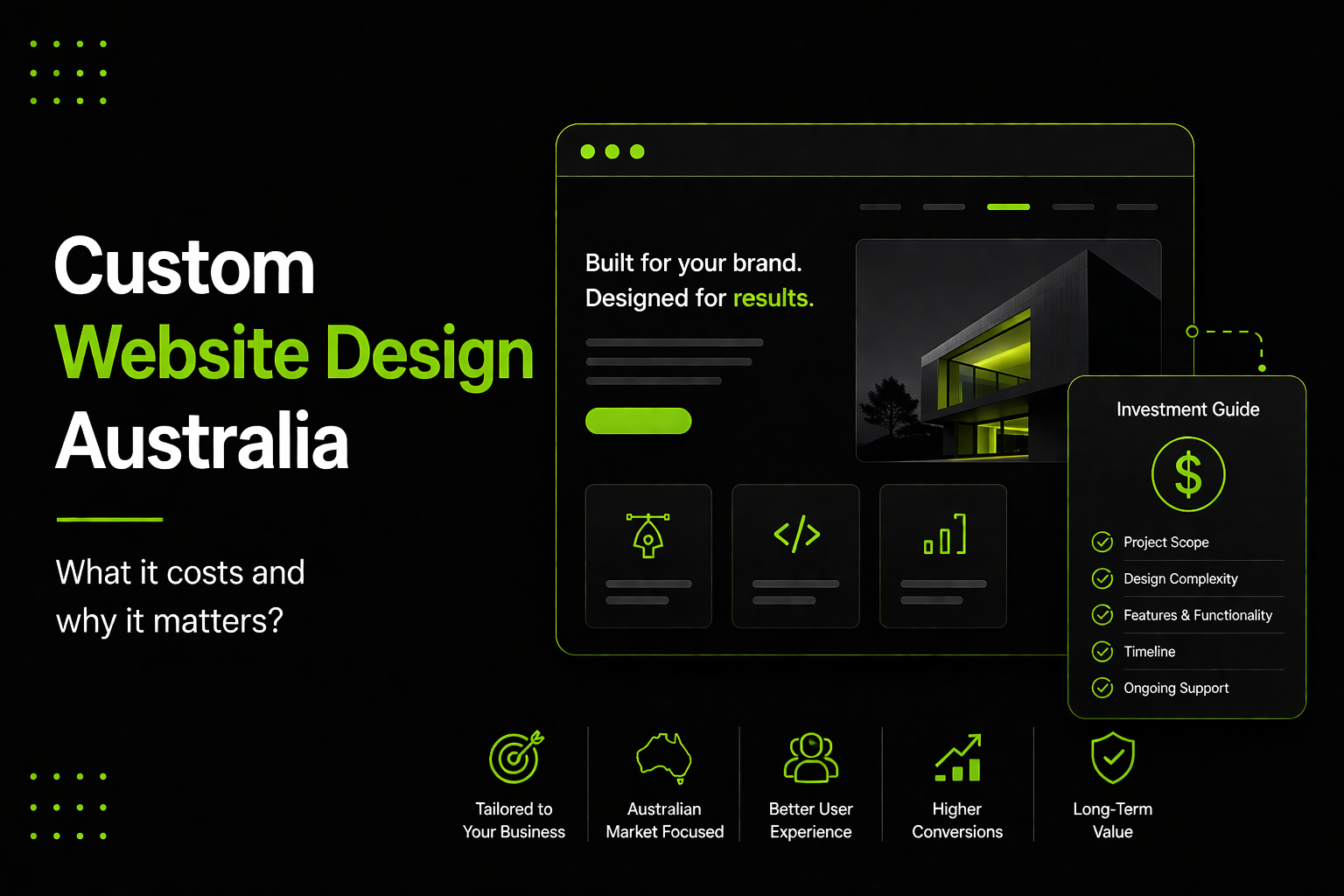
Every business with an online presence has made a choice — knowingly or not — between a custom website and a template. That choice has a bigger impact on your results than most business owners realise.
Template websites are fast and cheap to launch. Custom website design takes more time and investment upfront. But the difference in performance, brand perception, conversion rate and long-term scalability is significant. This guide explains what custom website design actually involves, what it costs in Australia, and how to decide whether it is right for your business.
What Is Custom Website Design?
Custom website design means your website is built from scratch, specifically for your business. There are no templates, no pre-made themes, no visual constraints from someone else's design system. Every layout, colour, component and interaction is designed with your brand, your audience and your goals in mind.
This is fundamentally different from using a website builder or a premium WordPress theme. Those platforms give you a starting point that you customise within predefined boundaries. Custom design starts with a blank canvas and builds every element deliberately. The result is a website that looks and feels uniquely yours — one that cannot be mistaken for a competitor's site.
For Australian businesses where the website is a primary customer acquisition channel, working with a professional web design company in Australia that builds custom is one of the highest-return digital investments available.
Custom Design vs Templates — The Real Differences
The choice between custom design and templates is not just aesthetic. It affects performance, flexibility, conversion and long-term cost.
- Brand differentiation — custom design reflects your brand precisely. Template sites, no matter how well customised, carry the visual DNA of thousands of other sites built on the same theme
- Performance — custom-coded websites are leaner and faster because they include only the code they need. Template sites often carry large amounts of unused code that slows load times
- Flexibility — custom design can accommodate any layout, feature or integration you need. Templates impose structural constraints that become expensive to work around as your requirements grow
- Conversion — a custom layout is designed around your specific user journey and conversion goals. Template layouts are built for the average use case, which is often nobody's actual use case
- Scalability — custom websites are architected to grow. Adding features, sections or integrations is cleaner and cheaper on a custom build than on a template site
The trade-off is cost and time. Custom website design requires more upfront investment. But for businesses where the website drives real revenue, that investment typically pays back through better conversion rates and lower long-term maintenance costs.
What Does Custom Website Design Cost in Australia?
Custom website design costs in Australia vary depending on scope, complexity and the team involved. A custom marketing website for a small business typically ranges from $5,000 to $15,000. A more complex corporate or ecommerce website sits between $15,000 and $50,000 or more.
The main factors that drive cost are:
- Number of unique page layouts — each custom layout requires dedicated design and development time
- Functionality — contact forms, booking systems, product catalogues, member areas and integrations all add scope
- Integrations — connecting to CRM, payment gateways, marketing automation or third-party APIs
- UX research and prototyping — whether the process includes user research and prototype testing before build
- Content volume — more pages and more content means more time at every stage
Ongoing costs include hosting, domain renewal, security and maintenance. A custom website built on clean architecture typically has lower ongoing maintenance costs than a heavily plugged template — but it does require a development partner for structural changes.
The Custom Website Design Process
Understanding the process sets accurate expectations and helps you make better decisions at each stage.
A professional custom web design process starts with discovery — documenting your goals, audience, competitors and content needs. UX strategy follows, mapping information architecture and user journeys before any visual design begins. Visual design comes next, usually starting with a homepage concept that establishes the visual direction, then expanding to all key layouts.
Development follows approved designs. Testing covers browser compatibility, device responsiveness, speed and functionality before launch. The best web design companies in Australia treat every stage as collaborative — involving you at key review points so nothing comes as a surprise at handover.
Whether you choose a starter website or a full custom build, the process should always include proper discovery, custom design and thorough testing. The web design packages available from professional agencies reflect these stages in their pricing.
SEO and Custom Website Design
One of the most underappreciated benefits of custom website design is its direct impact on search performance. A custom website is built with clean, semantic HTML structure, fast loading times and the ability to implement technical SEO correctly from day one.
Template sites often carry SEO liabilities — bloated code, poor heading structure, slow loading plugins — that need remediation work before they rank. A custom site eliminates those liabilities by design.
Good web design and SEO work together. A website that is fast, well-structured and easy to navigate signals quality to Google. A website that is slow and confusingly structured sends the opposite signal — regardless of how good the content is. Website speed is a ranking factor and a user experience factor simultaneously.
When Custom Website Design Is the Right Choice?
Custom website design is right when your business relies on your website as a primary acquisition channel, when your brand needs to stand out in a competitive market, or when your requirements exceed what template platforms can support cleanly.
It is also right when you are building for growth. A custom website built on solid architecture scales cleanly. You can add features, pages and integrations without hitting structural limitations.
For businesses testing an idea or with minimal online requirements, a template or website builder can be a practical starting point. But for any business where the website is a serious part of the customer experience — custom website design in Australia delivers measurably better results over time.
Custom website design works most effectively when combined with UX design thinking — planning user journeys and interface logic before the visual design begins. It also works best when responsive web design and mobile performance are treated as core requirements from the first wireframe, not as final-stage adaptations.
Frequently Asked Questions
Q1. What is the difference between custom website design and a template?
A custom website is designed and built from scratch for your specific business — with no pre-made themes or structural constraints. A template website uses a pre-built framework you customise within fixed limits. Custom design produces a unique, brand-specific website with better performance and more flexibility. Templates are faster and cheaper to launch but have limitations that grow more costly as your business evolves.
Q2. How much does custom website design cost in Australia?
Custom website design in Australia typically costs between $5,000 and $50,000+ depending on scope. A custom marketing website starts from around $5,000 to $15,000. Ecommerce and corporate websites with custom functionality range from $15,000 to $50,000 or more. The main cost drivers are unique page layout count, functionality requirements, integrations and the depth of UX research included in the process.
Q3. How long does a custom website design project take?
Most custom website design projects take between 6 and 16 weeks depending on scope and how quickly decisions are made on the client side. Simple marketing websites with modest page counts can be completed in 6 to 8 weeks. Larger corporate or ecommerce projects typically take 10 to 16 weeks from discovery to launch.
Q4. Is custom website design better for SEO?
Yes, in most cases. Custom websites are built with clean semantic code, fast loading performance and proper technical SEO structure from day one. Template sites often carry bloated code and structural issues that negatively affect SEO performance. A custom-built website gives your SEO strategy a clean and well-optimised foundation to build on.
Q5. Do I need a custom website if I already have a WordPress site?
Not necessarily. A well-built WordPress website serves most businesses effectively. Custom design becomes the right choice when your requirements exceed what WordPress themes support cleanly, when performance is critical, or when your brand needs a genuinely unique visual identity. A good web design company will advise you honestly on which path fits your situation.