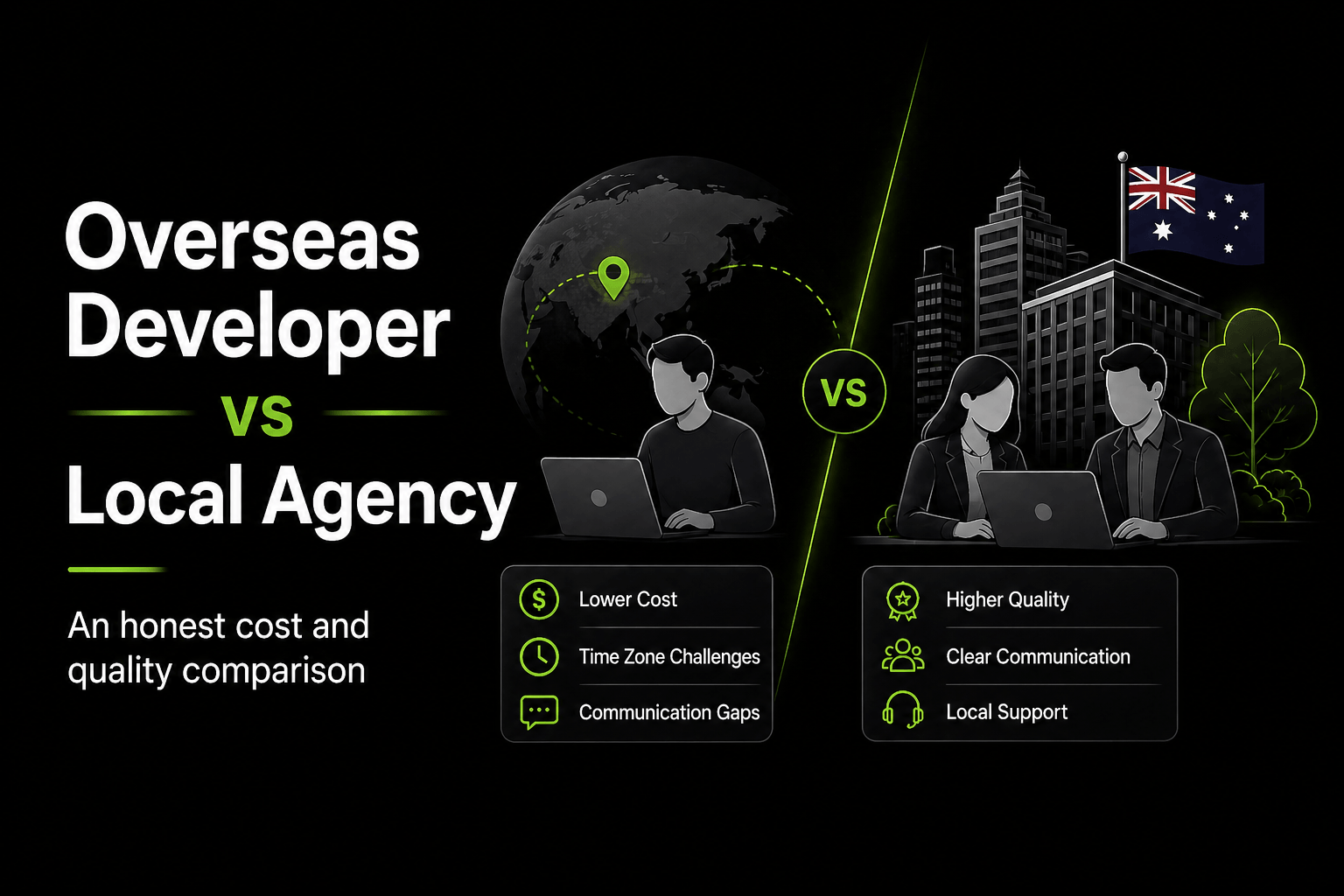
Hiring an Overseas Web Developer vs a Local Australian Agency — An Honest Comparison
The Appeal of Offshore Web Development
The pitch for offshore web development is straightforward. Developers in countries like India, the Philippines, Eastern Europe and South-East Asia charge significantly less per hour than Australian developers. For a business watching its budget, that headline rate is attractive.
The decision to hire overseas web developer talent or use an offshore agency is not a bad one by default. Many Australian businesses have had positive experiences with offshore development. But many have also experienced the opposite. The difference usually comes down to how thoroughly the real costs — not just the hourly rate — were evaluated before the decision was made.
This guide gives you an honest look at both options so you can make a decision based on the full picture, not just the quoted price.
The Real Cost of Offshore Web Development
The headline hourly rate for an offshore developer is typically 30 to 70 percent lower than an equivalent Australian developer. That is a real saving if everything else is equal. But everything else is rarely equal.
The hidden costs of offshore web development in Australia are well-documented by businesses that have experienced them. They include:
- Communication overhead — time zone differences mean that questions and feedback cycles that would take hours can take days. Each round of revisions introduces a delay
- Revision cycles — lower upfront clarity combined with language barriers often results in more revisions than comparable local projects, eating into the apparent cost saving
- Project management load — managing an offshore team requires significantly more detailed briefing, more active oversight, and more structured processes than working with a local partner
- Quality inconsistency — the quality range in offshore markets is wide. Without a strong vetting process, the risk of poor-quality code is higher
- Handover costs — if an offshore engagement ends badly, the cost of a local developer inheriting and cleaning up poorly structured code can be significant
- Time-to-market impact — slower iteration cycles mean slower launches, which has a real business cost that does not appear on an invoice
None of these costs are inevitable. With a good offshore partner and well-structured processes, many of them can be managed. But they need to be factored into your cost comparison, not ignored.
Quality and Accountability Differences
Quality in web development is difficult to assess from a proposal. The best indicators are documented past work, code samples, client references, and the clarity of the discovery and scoping process. These apply equally to offshore and local options.
Where local development companies in Australia tend to have a structural advantage is accountability. When something goes wrong — and in complex projects, something always requires attention — a local team operates in the same legal environment as your business. Contracts are enforceable under Australian law. You can pick up the phone in your time zone. You can, if necessary, meet in person.
With an overseas development team, contractual accountability is more complicated. Legal recourse across jurisdictions is expensive and slow. When things go wrong offshore, the practical options are often limited to renegotiation or abandoning the engagement. This risk is worth pricing into your decision, especially for projects where quality and reliability matter.
Australian Compliance and Privacy Standards
This is a factor that is frequently overlooked in the offshore vs local comparison. Australian businesses are subject to the Privacy Act 1988, which governs how personal data is collected, stored, used and shared. The Australian Privacy Principles apply to any organisation with an annual turnover above three million dollars, and to health service providers and credit providers regardless of turnover.
When you share customer data, business data or personal information with an offshore development team, you are transferring that data across borders. Australian Privacy Principle 8 governs cross-border disclosure of personal information, and it is explicit on accountability: an entity that discloses personal information overseas generally remains accountable for what the overseas recipient does with it (OAIC, APP 8 guidelines). Your business stays responsible for that data even when a third party in another country is processing it.
A local web development company in Australia operates under the same regulatory framework as your business. They understand the compliance requirements, they can be held accountable under Australian law, and they do not create cross-border data transfer risk.
When Offshore Development Makes Sense?
There are genuine scenarios where hiring overseas makes practical sense. If your project is very clearly defined with detailed specifications, if ongoing communication requirements are low, if the technology is standard and the risk of quality variance is manageable, and if you have strong internal technical capability to review and manage the work — offshore development can deliver good value.
Smaller, self-contained projects with limited integration requirements and clear acceptance criteria are the best fit for offshore development. The more complex, bespoke and strategically important your project is, the more the risks of offshore development compound.
When Local Development Is the Better Choice?
For the majority of Australian businesses building meaningful digital products, a local web development company Australia will deliver better total outcomes than offshore alternatives. This is particularly true for:
- Projects with complex or evolving requirements that need regular collaboration and fast iteration.
- Builds that integrate with multiple existing business systems.
- Businesses handling personal data where Privacy Act compliance is a priority.
- Projects where time-to-market is critical and revision delays are costly.
- Long-term partnerships where ongoing maintenance and evolution are expected.
- Businesses that have had poor offshore experiences and need reliable, accountable delivery.
The value a good local agency provides is not just the code. It is the communication, the strategic input, the accountability, and the collaborative relationship that makes complex projects succeed.
Questions to Ask Before You Hire — Offshore or Local
Regardless of which direction you are considering, these questions will help you evaluate any development partner more effectively.
- Can you show me three or more completed projects of similar scope, including live URLs?
- How do you handle project communication and what are your response time commitments?
- How do you manage scope changes and additional requests during the project?
- What is your process for quality assurance and testing before handover?
- Who specifically will be working on my project and what are their qualifications?
- How do you handle data privacy and what is your data management policy?
- What does post-launch support look like and what are the ongoing costs?
A good development partner — whether local or offshore — will answer these questions clearly and confidently. Vague answers, deflections, or promises without supporting evidence are warning signs regardless of where the team is based.
Making a Decision That Fits Your Business
The overseas web developer vs local comparison does not have a universal right answer. It has a right answer for your specific project, your risk tolerance, your communication preferences, and your compliance obligations. The businesses that make good decisions on this are the ones that evaluate the full cost and risk picture — not just the headline rate.
If budget is genuinely a constraint, a hybrid approach can work well. Use a local partner for strategy, architecture, project management and quality oversight, with offshore developers contributing to execution under that local direction. This captures some of the cost advantage while maintaining the accountability and quality control that a local lead provides.