
SEO for Healthcare Providers in Australia: How to Get Found by Patients Who Actually Need You?
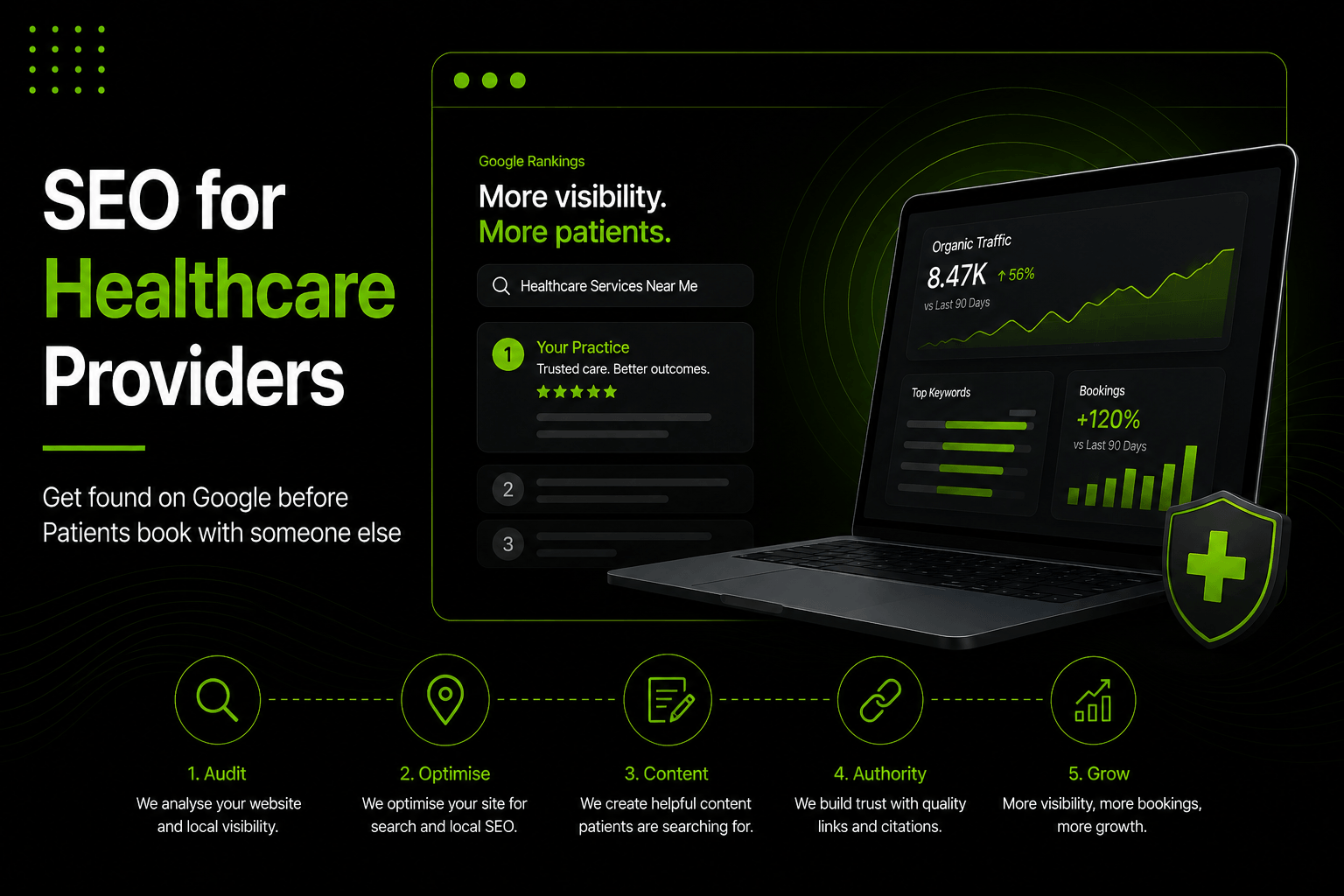
Why Healthcare Professionals Are Missing the Patients Searching for Them Right Now?
Every day, thousands of Australians open Google and search for healthcare providers in their area. They type "physiotherapist near me in Brisbane", "psychologist accepting new patients Melbourne", or "allied health services Perth". They are looking for someone exactly like you. But if your website is buried on page three of Google, they will never find you — and they will book with a competitor who invested in their digital presence.
Healthcare SEO is the practice of optimising your website so it ranks high in Google search results when patients search for the specific services you offer in your location. For healthcare providers across Australia, this is quickly becoming one of the most critical components of practice growth.
The days when healthcare businesses could rely purely on word-of-mouth and directory listings are fading fast. In 2026, the first place almost every patient goes before booking an appointment is Google. If your online presence is not strong, you are invisible during the most important moment — when a patient is actively looking for help.
The Unique SEO Landscape for Australian Healthcare Providers
Healthcare SEO operates differently to most other industries, and understanding those differences is essential to getting the strategy right.
The first unique factor is the trust requirement. Healthcare is a deeply personal decision. Patients are not just looking for any provider — they are looking for one they can trust with their physical and mental health. Google understands this. Healthcare content falls into what Google classifies as YMYL — Your Money or Your Life — which means it applies extra scrutiny to the quality, accuracy, and authority of content on healthcare websites.
The second factor is the dominance of local intent. Almost every healthcare search is local. "Occupational therapist Sydney", "NDIS provider Brisbane", "sports physio Melbourne" — these are searches made by people with a specific location in mind, often within a few kilometres of where they live or work. Local SEO is therefore the single highest-impact investment most healthcare providers can make.
The third factor is the competitive directory landscape. Platforms like HealthEngine, HotDoc, and local directory listings dominate many healthcare search terms. A strong SEO strategy needs to work around these directories rather than trying to compete with them directly, focusing on keywords and content opportunities where individual practice websites can genuinely rank.
The Difference Between a Healthcare Website That Ranks and One That Doesn't
Most healthcare websites in Australia suffer from the same core problems. They have a small number of generic service pages with minimal content. They have no location-specific pages. They publish no educational content that answers the questions patients are searching for. And their technical performance — page speed, mobile experience, structured data — is poor.
A healthcare website that ranks well does the opposite. It has detailed, accurate service pages that clearly explain each treatment or support offered. It has dedicated pages for each location it services. It publishes consistent educational content that answers real patient questions. And it is technically optimised to load fast on mobile, where the vast majority of healthcare searches now happen.
Local SEO: The Most Powerful Tool for Healthcare Practices
If you could only invest in one area of SEO as a healthcare provider, local SEO would deliver the fastest and highest return. Local SEO is the process of optimising your online presence so you appear in Google Maps and local search results when patients nearby are searching for your services.
The foundation of local SEO for healthcare providers is a fully optimised Google Business Profile. This free tool, when properly managed, allows your practice to appear in the local map pack — the three businesses that appear at the top of Google results with a map. Appearing in the map pack dramatically increases both visibility and patient enquiries.
A well-optimised Google Business Profile for a healthcare provider should clearly list all services offered, include accurate location and opening hours information, contain high-quality photos of the practice, actively gather and respond to patient reviews, and be kept consistently updated with posts and announcements.
Location Pages: Why One Website Serving Multiple Areas Needs Multiple Pages?
If your healthcare practice serves patients across multiple locations — for example, if you are a registered NDIS provider operating across Sydney and the Blue Mountains — a single generic website will not rank well for either location. Google needs to see dedicated, locally relevant pages to understand which areas you serve.
Creating individual location pages for each city or suburb you operate in is one of the highest-impact technical SEO moves available to healthcare providers. Each page should use location-specific keywords, reference local landmarks or communities where appropriate, include the specific services available at that location, and contain genuine, useful content rather than thin copy.
Content Strategy for Healthcare Websites: What Actually Ranks?
Educational content is the engine of healthcare SEO. When your website answers the real questions patients are searching for — about conditions, treatments, costs, timelines, and what to expect — you build topical authority that lifts the rankings of your entire website.
The most effective approach is to think about the specific questions your patients ask before, during, and after their first visit. These questions map directly to high-value content opportunities. A physiotherapy clinic might publish content about "how many sessions does physiotherapy take to work", "what to wear to your first physio appointment", or "physiotherapy vs chiropractic — which is right for my back pain".
Each of these answers a genuine patient question, targets a real search query, and builds trust with potential patients before they have ever set foot in your clinic.
The Role of Schema Markup in Healthcare SEO
Schema markup is structured data code added to your website that helps Google understand specific information about your healthcare practice — your services, location, opening hours, accepted insurance types, and the qualifications of your practitioners. For healthcare providers, implementing LocalBusiness and MedicalOrganization schema can improve how your website appears in search results, including enabling rich snippets that stand out from competitors.
Most healthcare websites in Australia have no schema markup at all, which means this represents a genuine quick-win opportunity for practices willing to invest in their technical SEO.
Reviews and Reputation: The SEO Signal Most Healthcare Providers Underestimate
Online reviews are one of the strongest local SEO signals for healthcare businesses. Google treats the quantity, quality, and recency of your Google reviews as a significant ranking factor for local searches. A healthcare practice with fifty recent, detailed reviews will consistently outrank one with five old reviews, even if the second practice has a better website.
Building a systematic approach to gathering patient reviews is one of the most cost-effective SEO investments a healthcare provider can make. This does not mean offering incentives for reviews — Google prohibits this. It means making it genuinely easy for satisfied patients to leave a review by providing a direct link, asking at the right moment in the patient journey, and responding professionally to every review received.
Healthcare SEO for Specific Provider Types in Australia
The right SEO strategy varies somewhat depending on your specific healthcare specialisation. Allied health providers including physiotherapists, occupational therapists, speech pathologists, and exercise physiologists face a highly competitive local search landscape and typically benefit most from aggressive local SEO and educational content strategies.
Mental health providers — psychologists, counsellors, and psychiatrists — need to be especially careful about how they communicate online, balancing SEO effectiveness with the sensitivity required in their field. Content should be helpful and accessible without being alarmist, and trust signals like credentials and professional memberships should be prominently displayed.
NDIS providers face a particularly important SEO opportunity given the scale of the scheme and the volume of online searches by participants and support coordinators. Read more about our dedicated SEO for NDIS providers approach to understand how this niche-specific strategy works.
How Long Does Healthcare SEO Take to Show Results?
This is the most common question healthcare providers ask before investing in SEO. The honest answer is that local SEO improvements — particularly to your Google Business Profile — can show measurable results within four to eight weeks. Website ranking improvements for competitive terms in major cities typically take three to six months of consistent effort.
The most important thing to understand is that SEO compounds over time. A healthcare practice that starts investing in SEO in mid-2026 will have a compounding advantage by 2027 that competitors who wait cannot easily replicate. Starting early and staying consistent is the winning formula.
At Ziff Digital, our healthcare SEO services are built on the same proven framework that powers our SEO work across multiple industries in Australia. We combine local SEO expertise, high-quality content creation, and technical optimisation to help healthcare providers rank higher, earn more trust, and attract more patients consistently. Our web development team also builds healthcare websites that are fast, accessible, and engineered for search from the ground up.