Why Your Competitor With a Worse Website Is Outranking You (And How to Fix It)?
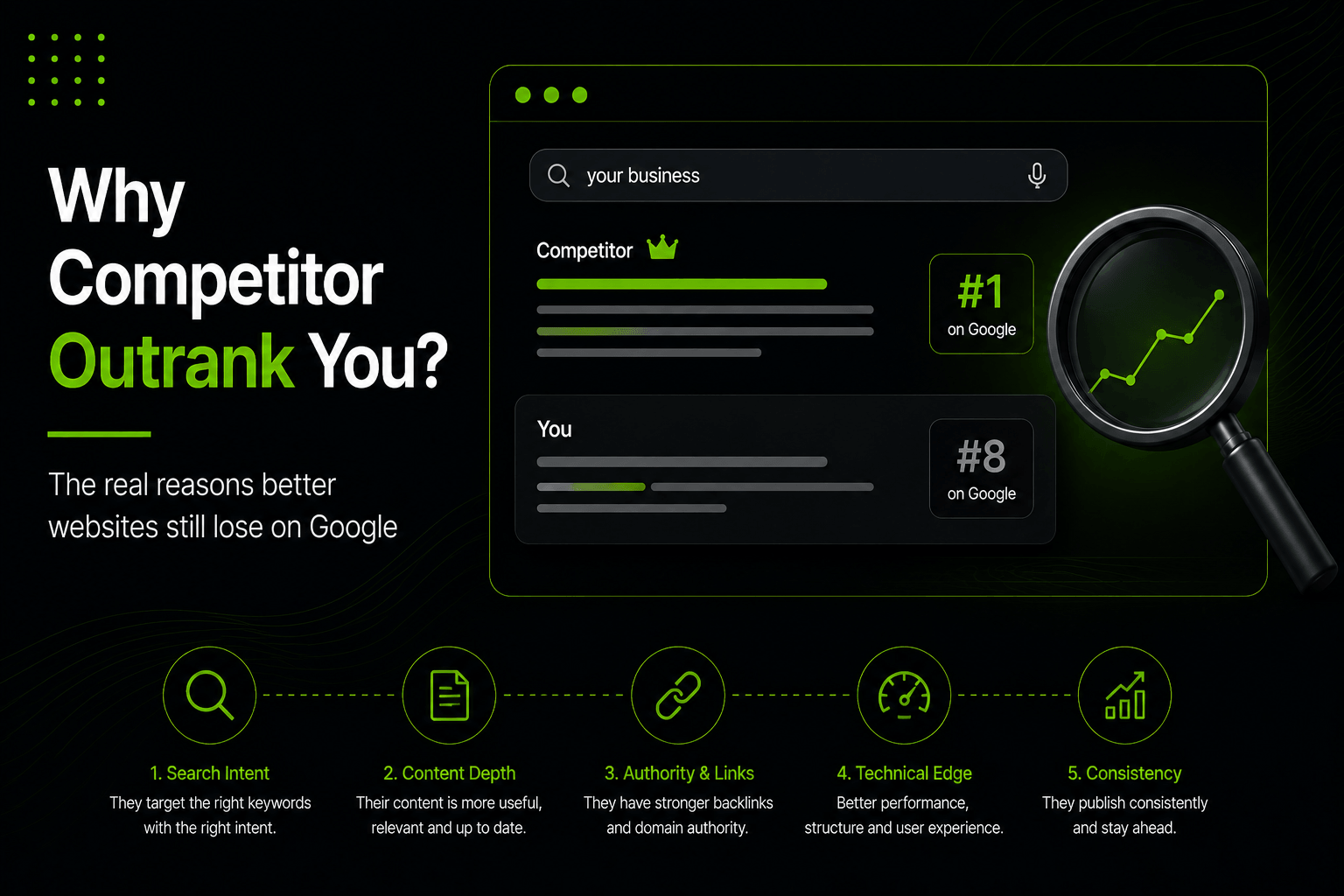
You have spent real money on your website. It looks professional. It loads well. The design is clean and modern. You are proud of it. And yet somehow, that competitor down the road — the one with a website that looks like it was built in 2014, with blurry photos and dated fonts — is sitting on page one of Google while you are buried on page three.
It is one of the most frustrating experiences in digital marketing. And it happens to businesses all across Australia every single day. The good news is that it is completely explainable. And once you understand why it is happening, fixing it is entirely within your control.
Google Does Not Judge Websites the Way Humans Do
This is the core thing most business owners miss. When you look at two websites side by side, you instantly trust the one that looks more polished and modern. That judgment is natural. But Google cannot see your beautiful design. It cannot appreciate your colour palette or your carefully chosen typography.
What Google sees is a set of technical and authority signals — and those signals have nothing to do with how visually appealing your website is. So when your competitor's old, clunky website outranks your new one, it means Google is seeing something important in theirs that it is not seeing in yours. Let us go through exactly what that is.
The Six Real Reasons They Are Outranking You
Reason #1: Their Domain Has Been Around Longer
Domain age and history are genuine ranking factors. A website that has been indexed by Google for eight years has built something called domain authority over time. Google has had years to verify that the site is real, consistent, visited, shared, and linked to. That accumulated trust history is something a brand-new website — however beautiful — simply cannot replicate instantly.
Your competitor's old website did not wake up one day with strong rankings. It earned them slowly over years through the basic act of being consistently present online. A new website needs time and a deliberate SEO strategy to close that gap. There are no shortcuts to trust in Google's eyes.
Key takeaway: Domain age builds compounding authority. You cannot rush it — but you can accelerate trust building through the strategies below.
Reason #2: They Have More Backlinks Pointing to Their Site
Backlinks are links from other websites pointing to your competitor. To Google, every backlink is essentially a vote of confidence — another website on the internet considers this business credible enough to reference. The more high-quality backlinks a site has, the more authority it carries in Google's ranking algorithm.
Your competitor's old website has probably accumulated backlinks over years without trying very hard. Local directories updated annually. An old mention in a regional newspaper. A supplier list on an industry association website. None of these are glamorous individually, but together they add up to a significant authority advantage.
What Makes a Backlink High Quality?
- It comes from a website that is relevant to your industry or location
- The linking website itself has strong domain authority
- The link is placed naturally within useful content — not in a footer or sidebar
- The anchor text (the clickable words) is descriptive and relevant
- The linking site is not part of a paid link scheme or low-quality directory
Reason #3: Their Content Has More Ranking History
Google tracks how content performs over time. A blog post that has been live for three years — shared, commented on, linked to, and consistently visited — has a completely different trust profile to a post published last week, even if the newer post is better written.
Your competitor may have dozens of blog posts and service pages that have been slowly building ranking history for years. Your new website is starting from zero. The answer is to understand that consistent content publishing, starting now, creates compounding returns over the next twelve to twenty-four months.
Reason #4: They Match Search Intent Better
Sometimes a simpler, thinner page outranks yours because it is a better match for what the person searching is actually looking for. Google's primary job is to return the most relevant result — not the most beautiful page.
If someone searches "emergency plumber Sydney" they want a phone number, a statement of 24/7 availability, and a clear suburb list. If your beautifully designed website buries all of that below a hero image and a long brand story, the basic competitor page that answers the question immediately wins. Every time.
How to Match Search Intent Correctly?
- Ask: what is the ONE specific thing someone searching this term actually wants?
- Put the most important information at the very top of the page
- Use clear headings that match the language of the search query
- Keep calls to action visible without scrolling on mobile
- Do not make visitors work to find the answer they came for
Reason #5: Their Technical SEO Is Stronger
A visually impressive website can be technically broken in ways that completely undermine its ability to rank. Technical SEO — the behind-the-scenes code and structure — plays a massive role in how Google indexes and ranks pages.
Common technical SEO problems that hurt new well-designed websites include slow page load speed, missing or duplicate meta titles and descriptions, broken internal links, no XML sitemap, missing structured data, poor mobile performance scores, and pages accidentally blocked from Google's crawlers.
Technical SEO Checklist to Run Right Now
- Test your page speed at Google PageSpeed Insights — aim for 70+ on mobile
- Check for crawl errors in Google Search Console
- Ensure every page has a unique, keyword-optimised meta title and description
- Confirm your XML sitemap is submitted and up to date
- Check that no important pages are accidentally set to noindex
- Test your website on three different mobile devices
Reason #6: They Have Stronger Off-Site Signals
Google uses a range of off-site signals to assess how real, relevant, and established a business is. These include the completeness and activity of your Google Business Profile, the number and recency of your Google reviews, the consistency of your business information across directories, and mentions of your brand across the web.
Your competitor may have been actively managing their Google Business Profile for years, consistently collecting reviews, and maintaining a steady presence across local directories. This off-site activity sends strong local trust signals that a new website simply has not had time to accumulate.
How to Fix It: Your Action Plan?
Step 1 — Build Backlinks Immediately
List your business in every relevant Australian directory. Reach out to industry associations. Ask partners and satisfied clients whether they would be willing to link to your website. Every legitimate backlink accelerates your authority growth and helps close the gap with longer-established competitors.
Step 2 — Publish Content Consistently
Businesses that publish sixteen or more blog posts per month generate four and a half times more leads than those that publish infrequently. Start building your content library now. A well-written, strategically targeted blog post every week builds topical authority and keyword coverage that compounds powerfully over twelve months.
Step 3 — Run a Full Technical SEO Audit
Get a proper technical audit done by an experienced SEO professional. Find and resolve every issue that is preventing Google from fully crawling, understanding, and trusting your website. This is often where the quickest ranking improvements are found.
Step 4 — Optimise Your Google Business Profile
Make sure every field is complete, your primary and secondary categories are accurate, your photos are current and well-labelled, and you have a consistent system for collecting Google reviews from satisfied clients. Local SEO improvements through your Business Profile often produce visible results within four to eight weeks.
Step 5 — Restructure Pages to Match Search Intent
For every key service page, ask yourself: what is the exact question this page is answering, and is that answer immediately visible when someone lands here? If no, restructure the page so the most important information is at the top and your call to action is prominent before the fold.
The Bottom Line
A beautiful website that nobody can find is just an expensive business card. Your competitor's old website is not beating yours because it is better — it is beating yours because it has had more time to build authority, backlinks, and content history. Every one of those gaps is closeable. Start with the actions above and the rankings will follow.