Why Blogging Is Still the Highest-ROI Marketing Activity for Australian Businesses in 2026?
Every few years, someone declares that blogging is dead. Podcasts killed it. Social media killed it. Short-form video killed it. AI killed it. And every time, the businesses that kept publishing blogs quietly watched their organic traffic grow, their lead volume increase, and their Google rankings climb - while everyone else chased the next shiny thing.
Blogging is not dead in 2026. In the right hands, with the right strategy, it remains the single highest long-term ROI marketing activity available to most Australian businesses. And the data from multiple credible sources backs this up completely.
The Numbers That Make the Case - Hard to Argue With
- Brands that prioritise blogging report around 13 times more ROI than brands that do not (HubSpot). It is a long-standing HubSpot benchmark rather than a 2026 measurement, so treat it as directional.
- SEO-focused content has averaged around 702% ROI over three years in First Page Sage's analysis of its own client campaigns - an agency benchmark rather than independent research.
- Small businesses that blog have reported around 126% more lead growth than those that do not (HubSpot) - a long-standing benchmark, not a 2026 measurement.
- Businesses publishing 16+ posts a month have reported around 4.5x more leads than infrequent publishers (HubSpot).
- A single blog post can generate consistent free organic traffic for an average of 3.5 years
Read those numbers again. Seven hundred and two percent ROI over three years. Thirteen times more likely to see positive ROI. One hundred and twenty-six percent more lead growth. These are not marginal improvements. These are transformational differences in business outcomes - driven by a single consistent activity.
Why the ROI Compounds Over Time?
Blogging produces these kinds of returns because it is one of the very few marketing activities where the asset you create gets more valuable over time rather than depreciating. Understanding this compounding mechanism is the key to understanding why consistent bloggers win.
Paid Advertising vs Blogging - The Core Difference
When you pay for a Facebook or Google ad, you get traffic while the ad is running. The moment you stop paying, the traffic stops completely. There is no residual value. Every month you want traffic, you pay again from zero.
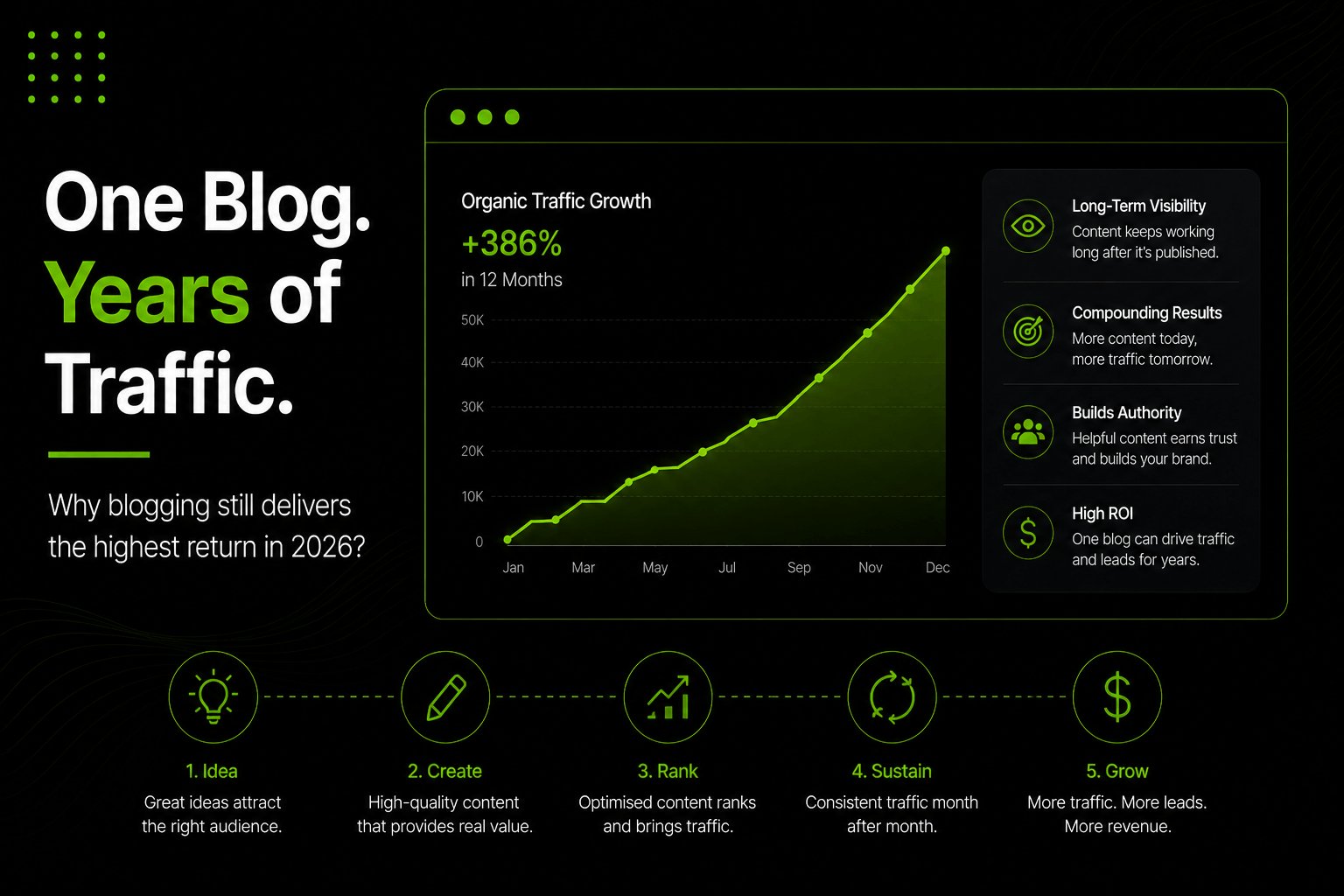
A blog post is fundamentally different. You invest the time and resources to create it once. It gets indexed by Google. Over the following weeks and months it gradually climbs the rankings for the keywords it targets. Within six to twelve months it may be generating consistent organic traffic every single day - without you spending another dollar. And then it keeps doing that for years into the future.
The Compounding Advantage Visualised
- Month 1-3: Post gets indexed, starts climbing for long-tail keywords
- Month 4-6: Rankings improve, consistent traffic begins
- Month 7-12: Post earns backlinks, authority grows, rankings strengthen
- Year 2-3: Post generates free traffic daily, cost per lead approaches zero
- Year 3+: Evergreen posts become your most valuable organic traffic assets
Businesses executing a consistent blogging strategy for twelve or more months typically see substantial compounding increases in organic traffic. Unlike paid traffic that stops when the budget runs out, organic traffic keeps compounding as you add more content to your library.
What Blogging Does Beyond Just Driving Traffic?
Traffic is the most measurable result of a consistent blogging strategy, but it is far from the only valuable outcome. A well-executed blog does several important things for your business at the same time.
It Builds Trust Before Anyone Contacts You
When potential clients find your website through a blog post that directly answers a question they were searching for, their first interaction with your business is a helpful, expert one. Before they have even read your services page, they already trust you. This trust significantly improves the conversion rate from website visitor to enquiry - because you have already demonstrated value before asking for anything.
It Powers Your Entire SEO Strategy
Every blog post you publish adds new pages to your website, each targeting different keywords and adding to the topical authority of your domain. A website with two hundred targeted blog posts signals to Google that it is a genuine expert in its field. Google rewards this with improved rankings across all pages - including your service pages, location pages, and homepage.
It Creates Content for Every Other Channel
Every blog post you write can be repurposed across every other marketing channel your business uses. This is not extra work - it is a multiplier on work you have already done.
One Blog Post → Multiple Content Assets
- Social media posts: pull out 5-7 key insights as individual posts across the week
- Email newsletter: summarise the post with a link to drive website traffic
- Short-form video: use each subheading as a script for a 60-second video
- LinkedIn article: adapt the content for a professional audience
- Podcast talking points: use the research as the basis for an episode
- Sales collateral: link to relevant posts during the sales process to build credibility
It Positions You for AI-Driven Search in 2026
There is a dimension to blogging's value in 2026 that did not exist even two years ago. Generative Engine Optimisation - the practice of ensuring your content is cited by AI tools like ChatGPT, Perplexity, and Google AI Overviews - relies heavily on having a library of authoritative, well-structured blog content.
When someone asks an AI tool a question relevant to your business, the AI draws from the most authoritative, clearly structured, and directly relevant sources it can find. A business with fifty well-researched blog posts covering topics relevant to their industry is far more likely to be cited in AI-generated answers than one with a sparse website and no blog. In 2026, blogging simultaneously builds your traditional SEO rankings and your AI search visibility.
Why Most Australian Business Blogs Fail to Deliver Results?
If blogging works this well, why do so many Australian business blogs produce almost no results? The answer is almost always one of three problems - and all three are completely avoidable.
Problem 1: Inconsistency
Blogging's compound returns require consistent publishing over time. A business that publishes enthusiastically for two months and then stops is not going to see the results. The businesses seeing seven hundred percent ROI are the ones that have been publishing consistently for twelve to twenty-four months without significant gaps. Consistency is the single most important variable.
Problem 2: Topic Selection Without Keyword Research
Writing about things that interest you or that you think are important is not the same as writing about things your potential clients are actively searching for. Every blog post should target a specific keyword that has real search volume and realistic competition levels for your domain. Without this, your content might be excellent but completely invisible because nobody is searching for it.
Problem 3: Publishing Without Promoting
A blog post that is published, shared once on social media, and then forgotten reaches a fraction of the audience it could reach. Promoting your content - through your email list, your social channels, relevant industry groups, and strategic outreach to related websites - dramatically accelerates the speed at which it builds authority and generates traffic.
What a High-Performing Blog Strategy Looks Like in Practice?
Before You Write: Research First
- Use Google Search Console to find keywords you are already close to ranking for
- Identify the specific questions your ideal clients ask before they contact you
- Research what your top three competitors are writing about and find their gaps
- Use keyword tools to confirm search volume before committing to a topic
When You Write: Structure for Humans and Google
- Posts between 1,500 and 2,500 words consistently outperform shorter content in rankings
- Use a clear H1 title containing your primary keyword
- Break content into scannable sections with descriptive H2 and H3 subheadings
- Include your keyword naturally in the first paragraph and several times throughout
- Add internal links to your relevant service pages from within every post
- End every post with a clear, relevant call to action
After You Publish: Promote and Maintain
- Share immediately across your social media channels with a compelling caption
- Include in your next email newsletter with a teaser and link
- Update your top-performing posts every six to twelve months with fresh information
- Track rankings and traffic in Google Search Console and Google Analytics
- Build internal links from newer posts back to your older well-performing posts
The Conclusion Is Simple
If your Australian business does not have a consistent, strategically driven blogging programme in place, you are leaving one of the highest-ROI marketing channels completely untapped. The businesses building content libraries right now are building compounding advantages that will be very difficult for competitors to replicate in the future.
The honest position: blogging's return is well evidenced in direction but poorly evidenced in precision. The widely quoted figures come from vendor benchmarks of varying age rather than independent research, so treat them as indicative rather than as measured outcomes you can forecast against. What is reliably true is that compounding organic content keeps returning traffic long after the spend stops, which paid channels do not.
The best time to start was two years ago. The second best time is today.