What Does an SEO Agency Do? Everything Explained (2026)
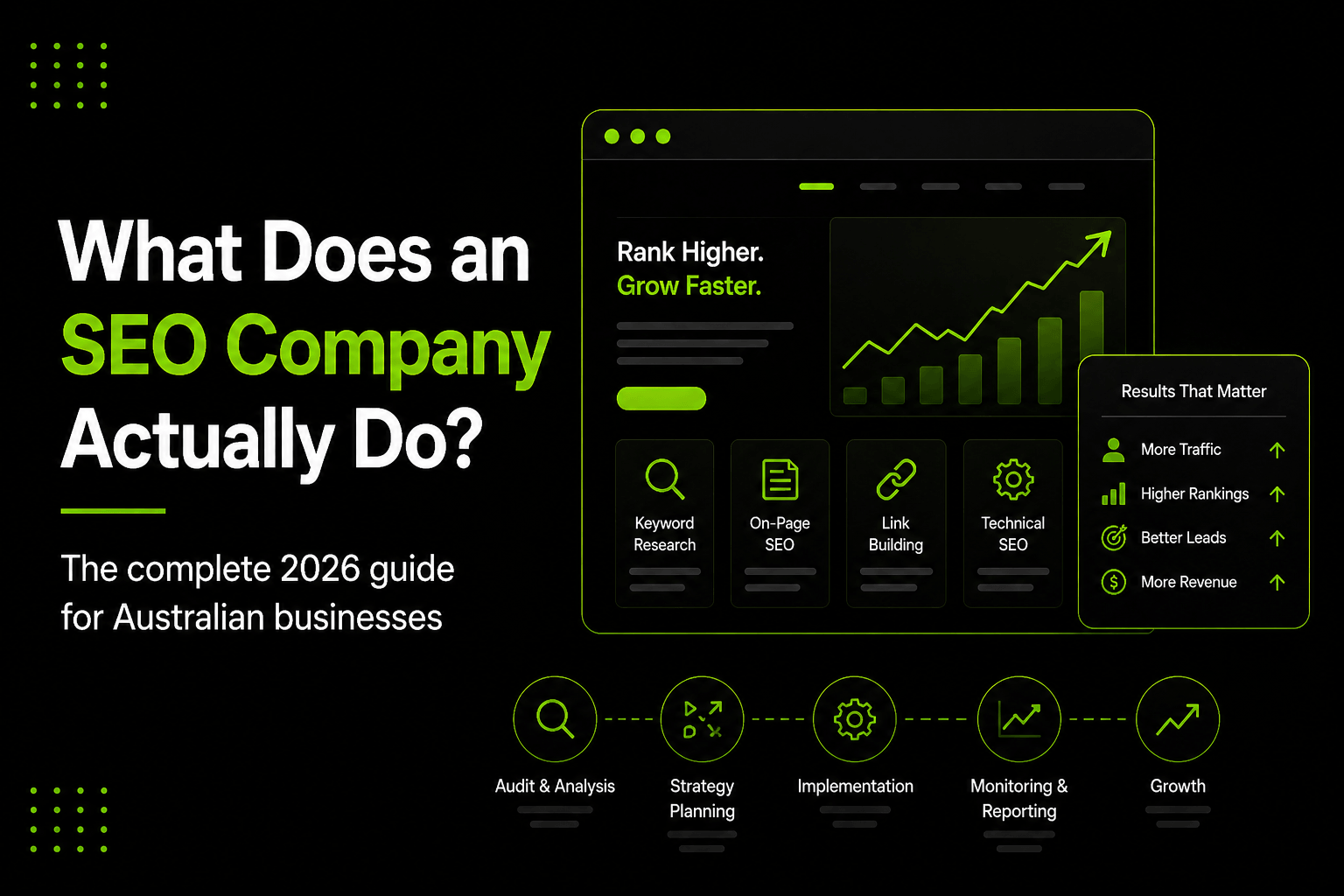
If you've been Googling 'what does an SEO company actually do' - you're in good company. Most business owners invest thousands into SEO without a clear picture of what they're actually paying for each month.
This guide cuts through the jargon. It explains exactly what an SEO agency does, why each activity matters, what to expect month by month, and - critically - how to tell whether yours is doing it right.
We've structured this as a complete reference: whether you're evaluating SEO services for Australian businesses for the first time, questioning your current agency, or just trying to understand how organic search actually works in Australia in 2026.
What Does an SEO Company Actually Do?
In plain English: an SEO company makes your website easier for Google to find, understand, and rank above your competitors. But that one sentence hides a lot of work.
A professional SEO agency typically works across five distinct areas simultaneously - and the skill is in knowing how to prioritise and sequence them for your specific business and market.
The 5 core things an SEO company does
- Finds the exact words and phrases your customers type into Google (keyword research)
- Fixes the technical issues stopping Google from reading your site properly (technical SEO)
- Improves and expands the content on your pages to match what searchers want (on-page SEO)
- Builds your site's credibility by earning links from other respected websites (link building)
- Tracks what's working, what isn't, and adapts the strategy accordingly (reporting & optimisation)
Each of these is explained in detail below. If you've been wondering 'what do SEO agencies do beyond just keywords?' - read on.
1. Keyword Research - Finding What Your Customers Actually Search For
Keyword research is where every SEO engagement starts. It's the process of identifying which words, questions, and phrases people type into Google when they're looking for what you sell.
But modern keyword research goes well beyond obvious terms. A good SEO agency in Australia will map out:
- High-intent commercial keywords - queries where someone is ready to buy or enquire (e.g. 'SEO agency Sydney' or 'web developer Melbourne')
- Informational keywords - questions your target audience asks before they're ready to buy (e.g. 'how much does SEO cost in Australia') - these build awareness and trust
- Long-tail keywords - specific, lower-competition phrases that convert at higher rates because the intent is so precise
- Local keywords - city, suburb, and 'near me' variations that capture nearby buyers
- Competitor gap keywords - terms your competitors rank for that you currently don't
What this looks like in practice?
For a business like Ziff Digital, keyword research wouldn't just identify 'SEO agency Australia' as a target. It would uncover a full keyword universe: 'what does an SEO company actually do', 'seo company for law firms', 'geo agency Australia', 'affordable NDIS SEO services', 'enterprise web development Australia' - each mapped to the most relevant page on the site.
The output is a keyword map: Every target keyword assigned to the exact page that should rank for it, with a priority ranking based on search volume, competition, and commercial value. This document guides everything else the agency does - if you want to go deeper on this process, our guide on how to conduct keyword research that drives real conversions walks through the full methodology step by step.
What separates good keyword research from bad?

separates good keyword research from bad
2. Technical SEO - Making Your Site Easy for Google to Read
This is the part most business owners never see - but technical SEO foundations are often what makes or breaks a campaign. They ensure that Google can crawl, understand, and index every page of your website without obstruction.
Think of it like this: you could have the best content in your industry, but if your website takes 8 seconds to load, has broken internal links, or confuses Google with duplicate pages - none of that content will rank.
What a technical SEO audit covers?
- Site speed and Core Web Vitals - Google uses page experience signals as ranking factors. Slow sites rank lower, especially on mobile. Use our website speed testing guide to benchmark your current performance and identify exactly what's slowing your pages down.
- Mobile responsiveness - a large share of Australian local searches happen on mobile. A site that works poorly on phones will rank and convert poorly.
- Crawlability and indexing - ensuring Google can access and read all your important pages (and that it's not accidentally blocked by a robots.txt error)
- Structured data / schema markup - adding code that helps Google understand what your page is about and display rich results (FAQs, reviews, prices) in search results
- Internal linking structure - how pages link to each other affects how Google distributes ranking power across your site
- Duplicate content and canonicalisation - ensuring Google knows which version of a page is the 'master' and doesn't split ranking power across duplicates
- HTTPS and security - now table stakes for ranking; sites without HTTPS are actively penalised in Google's trust assessment
- XML sitemap and robots.txt - ensuring Google has a clear roadmap of your site and knows what to index
Technical SEO in 2026: what's changed?
Google's 2026 core updates have raised the baseline significantly. Technical compliance that was optional in 2023 - like FAQ schema, Core Web Vitals optimisation, and AI-readable content signals (including llms.txt for AI crawlers) - is now a competitive necessity for Australian businesses targeting any moderately competitive keyword.
Quick indicator: is your agency doing real technical SEO?
- They send you a monthly report showing Core Web Vitals scores
- They've audited your schema markup and added FAQ, Article, or LocalBusiness structured data
- They flag when Google Search Console shows crawl errors or indexing issues
- They've reviewed your internal link structure and suggested improvements
- They've tested your site speed on mobile, not just desktop
3. On-Page SEO - Optimising What's Already on Your Site
On-page SEO is the process of making each page of your website as relevant and useful as possible for the specific queries you want it to rank for. It's where keyword research meets content.
What on-page optimisation includes?
- Page titles and meta descriptions - the text that appears in Google search results. These are your first impression in the SERP and directly impact CTR.
- Heading structure (H1, H2, H3) - how you organise information on a page signals topical relevance to Google. A well-structured page is easier for both Google and readers to understand.
- Content depth and comprehensiveness - Google in 2026 rewards pages that answer a topic thoroughly. A 300-word page rarely outranks a 1,500-word page that genuinely covers the subject.
- Keyword placement - primary keywords should appear naturally in the title, first paragraph, at least one H2, and throughout the body content. Not stuffed, but present.
- Image optimisation - file sizes, alt text descriptions, and descriptive filenames all contribute to relevance and page speed.
- Internal links - linking relevant pages together helps Google understand your site's structure and passes ranking authority from strong pages to weaker ones.
- Content freshness - updating posts with new information, statistics, and examples signals to Google that the content is maintained and current.
The role of E-E-A-T in on-page SEO
Google's guidelines now heavily weight E-E-A-T: Experience, Expertise, Authoritativeness, and Trustworthiness. For Australian businesses in any professional or YMYL (Your Money or Your Life) category - including finance, health, legal, and marketing - on-page optimisation must go beyond keywords.
It means including:
- Author bios with real credentials and experience
- First-person examples and case studies that demonstrate actual experience
- Cited statistics and data from reputable Australian sources
- Social proof - reviews, client logos, case study results
- Clear business information - ABN, physical address, team photos, and contact details
Generic, keyword-stuffed content no longer competes. Pages that signal genuine expertise - written by people who actually do the work - are pulling ahead across every competitive Australian keyword category.
4. Link Building - Earning Your Site's Reputation Online
A backlink is when another website links to yours. Google treats backlinks as votes of confidence - evidence that other people on the internet consider your site worth referencing. The more quality backlinks you have, from relevant and authoritative sources, the more Google trusts your site.
This is one of the most misunderstood and most abused areas of SEO. Done correctly, it's one of the most powerful ranking levers available. Done poorly - with cheap, bulk, or irrelevant links - it can result in penalties and ranking drops.
What legitimate link building looks like?
- Digital PR - creating genuinely useful, data-led content (original research, surveys, expert guides) that earns links naturally when other websites reference it
- Guest content - contributing expert articles to relevant Australian industry publications, with a contextual link back to your site
- Podcast appearances and media mentions - building real brand presence offline and online that generates citations
- Partnerships and supplier relationships - earning links from legitimate industry partners, associations, and directories
- Broken link reclamation - finding references to your brand or topic where the original link is broken, and requesting it be updated to your page
What to avoid (and what red flags look like)?
Red flags: link building tactics that will hurt your rankings
- Bulk link packages - '500 backlinks for $99' - these are spam links that Google ignores or penalises
- PBNs (Private Blog Networks) - fake networks of sites built purely to sell links, now easily detected by Google
- Unrelated directory submissions - links from irrelevant international directories carry no value
- Link exchanges - 'I'll link to you if you link to me' arrangements without editorial merit
- Paying for links without editorial process - Google's guidelines explicitly prohibit paid links that pass PageRank
5. Content Strategy - Building Topical Authority Over Time
Beyond optimising existing pages, a good SEO agency helps you build a content programme - a planned library of articles, guides, and landing pages that together signal to Google that your site is the most authoritative resource on your topic.
This concept is sometimes called topical authority or semantic clustering. The idea: a website that has 30 pages comprehensively covering every aspect of SEO for Australian businesses will consistently outrank a website that has one page about SEO - even if that one page is well-optimised.
What a content strategy looks like?
- Pillar pages - comprehensive, long-form guides that cover a core topic (e.g. 'The Complete SEO Guide for Australian Businesses')
- Cluster pages - supporting articles that cover subtopics in depth (e.g. 'What does an SEO company actually do', 'How much does SEO cost in Australia', 'How long does SEO take')
- Industry-specific pages - content targeting a specific vertical or audience, for example SEO for law firms in Australia, SEO for NDIS providers, and SEO for dental practices each require entirely different keyword strategies and content approaches.
- Location pages - city and suburb-specific landing pages for businesses targeting local clients, for example a page built specifically around web development Melbourne will rank for that term far more effectively than a national page that mentions Melbourne in passing.
- FAQs and question-based content - directly targeting question queries that appear as featured snippets
Content that ranks in 2026 vs content that doesn't

Content that ranks in 2026 vs content that doesn't
6. Local SEO - Getting Found by Customers Near You
For any Australian business that serves a specific city, suburb, or region - local SEO is often the highest-ROI part of an SEO strategy. Local SEO focuses on ranking in Google Maps (the '3-pack') and location-specific search results.
What local SEO includes?
- Google Business Profile (GBP) management - optimising your GBP with accurate categories, services, photos, Q&A, posts, and review responses. The GBP 3-pack is responsible for the majority of local clicks.
- Local citation building - ensuring your business name, address, and phone number (NAP) is consistent across all relevant Australian directories (Yellow Pages, True Local, Hotfrog, industry-specific directories)
- Location-specific landing pages - dedicated pages for each city or suburb you serve, for example targeting SEO agency in Sydney as a standalone page rather than relying on your national services page to rank for that term.
- Review management strategy - Google's algorithm increasingly weights review volume and recency. A structured approach to requesting and responding to reviews is essential.
- Local link building - earning mentions and links from local Australian news outlets, councils, chambers of commerce, and industry associations
For any service business - trades, professional services, healthcare, legal - local SEO is typically where the fastest wins come from. Work through our Australian local SEO checklist to make sure every signal Google uses to rank local businesses is fully covered on your site.
7. GEO - The New Frontier: Getting Found in AI Search
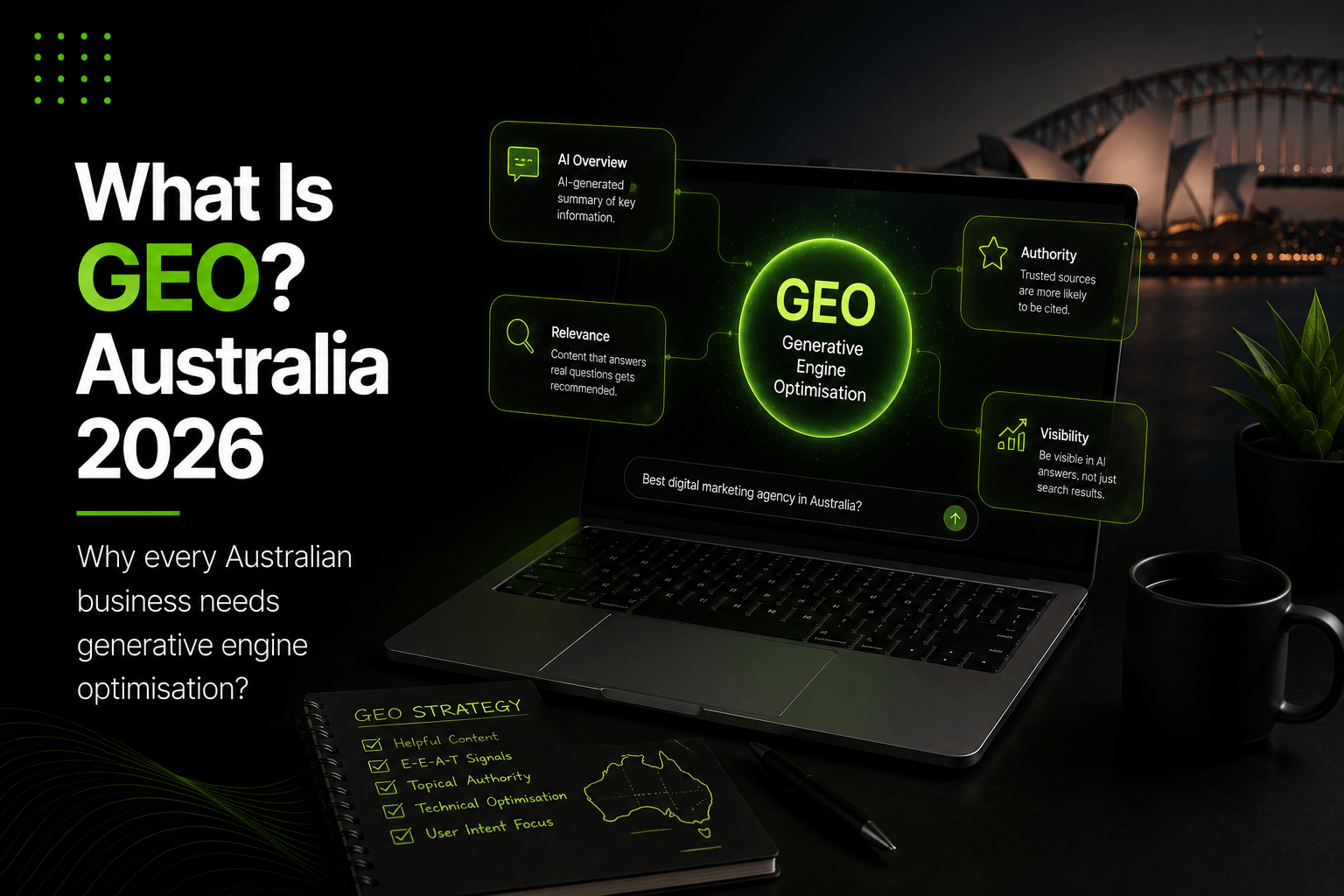
Search in 2026 isn't only happening on Google. A growing number of Australians are asking questions through AI platforms - ChatGPT, Google's AI Overviews, Gemini, Perplexity, and Claude. Generative engine optimisation (GEO) is the practice of optimising your content and brand signals to appear in those AI-generated answers - and it's becoming as important as traditional SEO for Australian businesses that want to stay visible as search behaviour shifts.
This matters because AI search works differently from traditional search. Instead of returning a list of links, AI platforms synthesise an answer and cite sources they trust. If your content isn't structured in a way that AI systems can understand and reference, you become invisible to this growing segment of searchers. For businesses exploring how AI fits into their broader digital strategy, our guide to AI consulting for Australian businesses explains how to evaluate and implement AI-driven growth tools effectively.
What GEO involves?
- Entity optimisation - ensuring Google and AI systems have a clear, consistent understanding of who your business is, what it does, and why it's an authority
- Citation-ready content - structuring content with clear claims, cited evidence, and authoritative references that AI systems can quote and attribute
- Brand signal building - getting your business mentioned on high-authority third-party sites, podcasts, directories, and publications that AI systems trust
- Structured data for AI - implementing schema markup and content structure that helps AI crawlers extract and represent your content accurately
- Answer-intent content - writing direct, specific answers to questions that AI systems can excerpt as cited responses
Ziff Digital: one of Australia's only agencies offering both SEO and GEO
- Most SEO agencies focus exclusively on Google search rankings.
- Ziff Digital combines traditional SEO with GEO - ensuring clients are visible in both Google results and AI-generated answers.
- As AI search adoption grows in Australia, GEO is transitioning from a competitive advantage to a baseline requirement.
- Ask us how your business currently appears (or doesn't appear) in ChatGPT, Gemini, and Perplexity answers.
8. What Should an SEO Agency Report On Every Month?
This is where many client-agency relationships break down. An SEO agency that only sends you a traffic chart is not giving you the information you need to evaluate whether your investment is working.
Here's what a comprehensive monthly SEO report should include - and what to ask for if yours doesn't cover it. If you're unsure whether your current campaign is delivering, read our full breakdown of how to know if SEO is working for a clear framework to evaluate performance.

SEO Agency Report On Every Month
9. How Long Does SEO Take? A Realistic Australian Timeline
This is the most common question - and the most commonly lied about. Agencies that promise 'page 1 in 30 days' are either targeting keywords with no competition (and therefore no value) or using tactics that will eventually penalise your site.
Here's an honest, experience-based timeline for what to expect from a professional SEO campaign in Australia:

How Long Does SEO Take
The businesses that get the best SEO results in Australia are the ones who treat it as a 12-month commitment, stay engaged with their agency, and measure success over quarters - not weeks. Ready to get started? Get a free SEO audit from the Ziff Digital team and we'll show you exactly where your biggest ranking opportunities are.
10. How Much Does SEO Cost in Australia in 2026?
SEO pricing in Australia varies enormously - from $500/month for basic packages to $10,000+/month for enterprise campaigns. Here's a practical guide to what different investment levels actually deliver:

How Much Does SEO Cost in Australia in 2026
The most important benchmark isn't how much you spend - it's the cost per qualified lead from organic search versus your other channels. A $3,000/month SEO investment that generates 20 qualified leads/month has a cost per lead of $150. If your Google Ads delivers the same leads at $300 each, SEO is twice as efficient.
11. How to Choose the Right SEO Agency in Australia
With hundreds of SEO agencies operating in Australia, the quality range is enormous. Here's a practical framework for evaluating any agency before you sign a contract.
5 questions every Australian business should ask
1. Can they rank their own website?
Search Google for 'SEO agency [your city]'. Does the agency appear? If they can't rank themselves, take any claims about ranking you with scepticism.
2. Do they have case studies in your industry?
Generic case studies with vague results ('increased traffic by X%') tell you little. Ask for specific ranking movements on named keywords and actual lead volume changes.
3. What does the reporting look like?
Ask to see a sample report. If it only shows traffic, not leads or conversions, your ROI will always be unclear.
4. Who actually does the work?
Most agencies use offshore teams for execution. That's normal and fine - but ask directly. Misleading answers here are a red flag for the whole relationship.
5. What happens to your content and rankings if you leave?
Content your agency writes should belong to you. Backlinks earned should remain. Never sign a contract where the agency owns your content or can remove links if you leave.
Green flags when evaluating an SEO agency
- They rank well for their own target keyword
- They talk about your business goals before SEO tactics
- They give you realistic timelines - not promised rankings within 30 days
- They explain what they're doing in plain language, not just jargon
- They proactively flag risks (algorithm updates, content gaps, technical issues)
- Their reporting shows leads and conversions - not just rankings and traffic
12. Frequently Asked Questions About SEO Companies
Q: What does an SEO company actually do each month?
Every month, a professional SEO company should be working across multiple areas simultaneously: reviewing keyword rankings and identifying opportunities, checking technical health in Google Search Console, updating or creating content, building quality backlinks, managing your Google Business Profile (for local clients), and sending you a detailed report connecting all of this to your traffic and lead volume. The exact mix shifts over time - early months are heavier on technical work and strategy; later months shift toward content creation and link acquisition.
Q: What is the difference between an SEO company and an SEO agency?
The terms are used interchangeably in Australia. 'SEO company' and 'SEO agency' both refer to a business that provides search engine optimisation services. Some agencies prefer 'agency' to signal a full-service approach; some use 'company' to sound more established. The distinction that actually matters isn't the name - it's whether they're a generalist digital agency (who offer SEO alongside many other services) or a specialist SEO firm (who focuses exclusively or primarily on organic search).
Q: How long does SEO take to work in Australia?
Most Australian businesses see their first meaningful ranking improvements within 3-4 months of starting a professional SEO campaign. The first 2 months are typically spent on foundations - technical fixes, keyword research, and initial content - which don't immediately move rankings but are essential. From month 3 onwards, rankings begin to move, especially for lower-competition keywords. For highly competitive terms (like 'personal injury lawyer Sydney' or 'SEO agency Melbourne'), reaching page 1 can take 9-12 months. The timeline depends heavily on how competitive your market is and the starting condition of your website.
Q: How much does SEO cost for a small business in Australia?
For a small Australian business targeting one city or a specific local area, a professional SEO investment typically starts at $1,000-$2,500 per month. Below $1,000/month, you're generally getting basic on-page work with minimal content or link building - which is unlikely to produce meaningful results in a competitive market. Most growing SMEs targeting multiple cities or a national keyword set invest $2,500-$5,000/month. The key question isn't the cost in isolation - it's the cost per qualified lead compared to your other channels like Google Ads.
Q: What's the difference between SEO and GEO?
SEO (Search Engine Optimisation) focuses on ranking in traditional search engines like Google - the blue links that appear in search results. GEO (Generative Engine Optimisation) is a newer practice focused on appearing in AI-generated answers from platforms like ChatGPT, Google AI Overviews, Gemini, and Perplexity. As more Australians use AI platforms to answer questions and find businesses, GEO is becoming an increasingly important complement to traditional SEO. The two disciplines overlap significantly - high-quality, well-structured content serves both - but GEO also requires specific attention to entity signals, citation building, and answer-intent content.
Q: Can my business do SEO without an agency?
Yes, but with significant caveats. Basic SEO tasks - writing good page titles, creating quality content, getting listed on Google Business Profile - are within reach for most business owners. What's difficult to do well without an agency is the technical side (structured data, Core Web Vitals, crawl issue diagnosis), link building (which requires relationships and outreach at scale), and the ongoing analysis needed to adapt strategy based on ranking movements and algorithm changes. For businesses in competitive markets, DIY SEO typically delivers 10-20% of what a professional agency delivers, because the competition isn't doing it themselves.
Q: What industries benefit most from SEO in Australia?
SEO delivers strong results for almost every industry, but particularly for: professional services (law, accounting, financial planning, HR), healthcare (dentists, physios, specialists, NDIS providers), trade services (plumbers, electricians, builders, landscapers), real estate, ecommerce, education and training, technology and SaaS companies, and hospitality. Any business where customers search Google before making a purchase or booking decision - which is most businesses - can benefit from professional SEO.
Q: What should an SEO agency report on?
A professional SEO agency should report monthly on: keyword ranking movement for your target terms, organic traffic growth (sessions and users from organic search), organic conversions and leads, backlink acquisition and profile health, technical SEO health (crawl errors, Core Web Vitals, indexing issues), and - for local businesses - Google Business Profile performance (views, clicks, calls). If your agency only sends a traffic chart, ask for more. The most important metrics connect SEO activity to actual business outcomes: enquiries, bookings, or sales from organic search.
Q: Is it worth paying for SEO in Australia?
For most Australian businesses in established markets, yes - with realistic expectations. First Page Sage, analysing its own client campaigns run between 2021 and 2025, reports an average SEO ROI of 748% over a 36-month period. It is a widely cited industry benchmark, though it reflects one agency's engagements rather than independent research - treat it as an indication of upside, not a forecast. The key word is 'correctly': low-budget, generic SEO in a competitive market typically delivers poor results. The businesses that get the best ROI from SEO treat it as a 12-month strategic investment, choose an agency with demonstrated industry experience, and measure success in leads and revenue - not just traffic.
Q: What's the difference between white hat and black hat SEO?
White hat SEO uses strategies that comply with Google's guidelines: creating genuinely useful content, earning quality backlinks through editorial merit, and building a technically sound website. Black hat SEO uses manipulative tactics to game rankings short-term: buying bulk links, stuffing keywords, creating fake pages, and cloaking content. Black hat tactics can produce quick results but almost always result in Google penalties - ranking drops or complete removal from search results - that are very difficult and expensive to recover from. All reputable Australian SEO agencies use white hat strategies exclusively.