What Is Generative AI and How Does It Work?
What Is Generative AI?
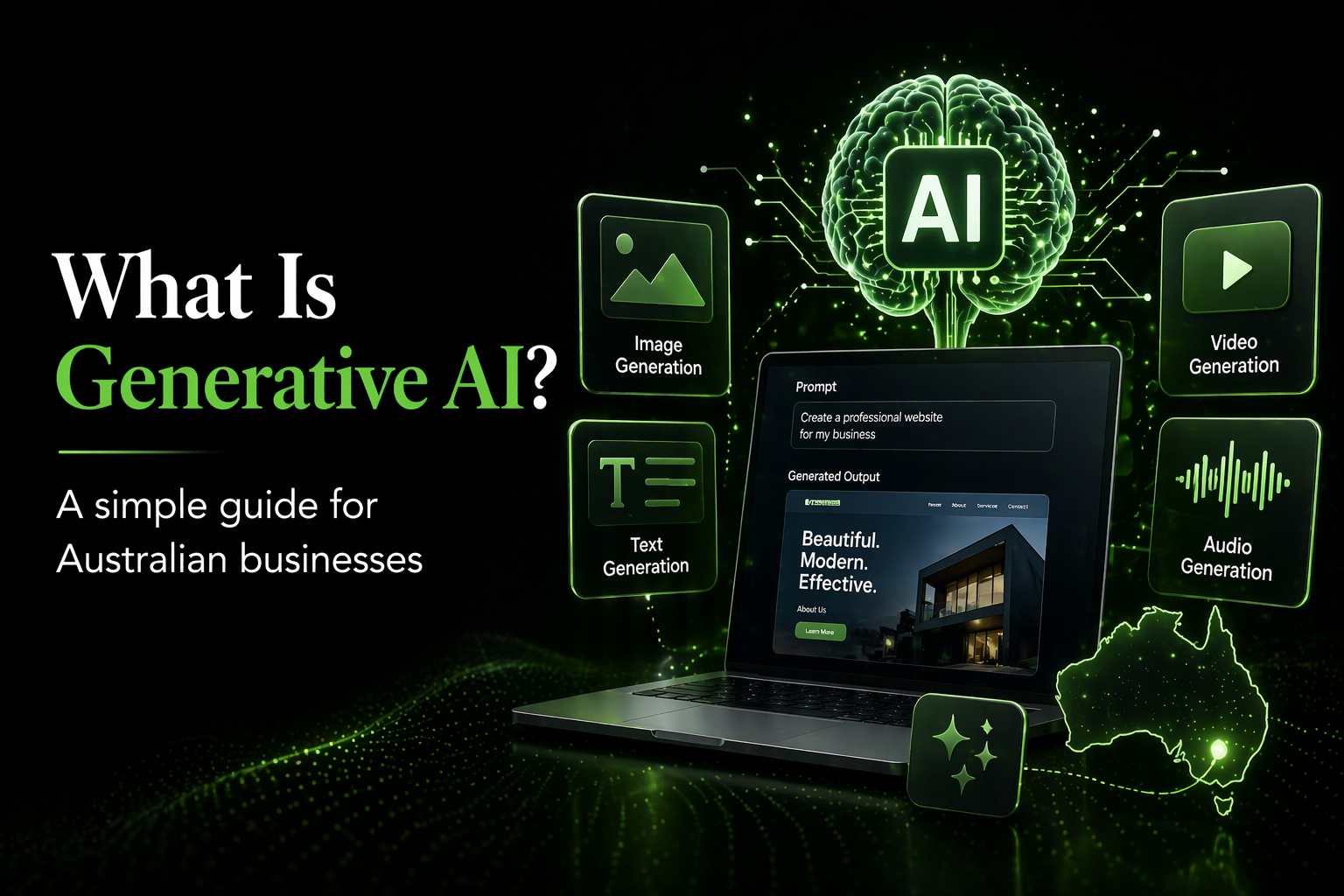
Generative AI is a type of artificial intelligence that creates new content. Instead of just analysing data or following a fixed set of rules, it produces original outputs - things like written text, images, audio, video, and code. It does this by learning patterns from large amounts of existing data and then using those patterns to generate something new.
If you have ever typed a question into ChatGPT and received a written response, you have used generative AI. If you have seen AI-generated images online, that is generative AI too. The technology is no longer experimental. It is in use right now by businesses across Australia and around the world.
Understanding what generative AI is and how it works is the first step to knowing whether it can help your business. This guide explains the core concepts in plain English - no technical background required.
How Does Generative AI Actually Work?
Generative AI works by training large AI models on enormous datasets. During training, the model reads through vast amounts of text, images or other content and learns the relationships and patterns within that data. Once training is complete, the model can use those learned patterns to generate new content based on a prompt or instruction.
The most common type of generative AI for text is called a Large Language Model, or LLM. These models are trained on billions of words from books, websites, articles and other sources. When you give an LLM a prompt, it predicts what words or ideas should come next based on everything it has learned. The result feels like a coherent, intelligent response - because in many ways it is.
For images, generative AI models work differently. They learn the relationship between descriptions and visual content, then generate images that match a given description. The same principle applies to audio and video generation.
What Are Foundation Models in Generative AI?
Foundation models are very large AI models that have been pre-trained on broad datasets. Think of them as the base layer of intelligence. GPT-4, Gemini, Claude, and LLaMA are all examples of foundation models. They are designed to be general-purpose - capable of handling many different types of tasks.
When businesses build custom AI systems, they often start with a foundation model and then fine-tune it using their own specific data. This process, called fine-tuning or custom training, makes the model more accurate and relevant for a particular industry, brand or use case. The result is an AI system that understands your business, speaks your brand voice, and produces far better outputs than a generic public tool.
Generative AI vs Traditional AI - What Is the Difference?
Traditional AI systems are designed to analyse, classify or predict. They look at data and answer questions like: is this email spam? Will this customer churn? Which product is most likely to sell? These systems are excellent at structured tasks with clear right or wrong answers.
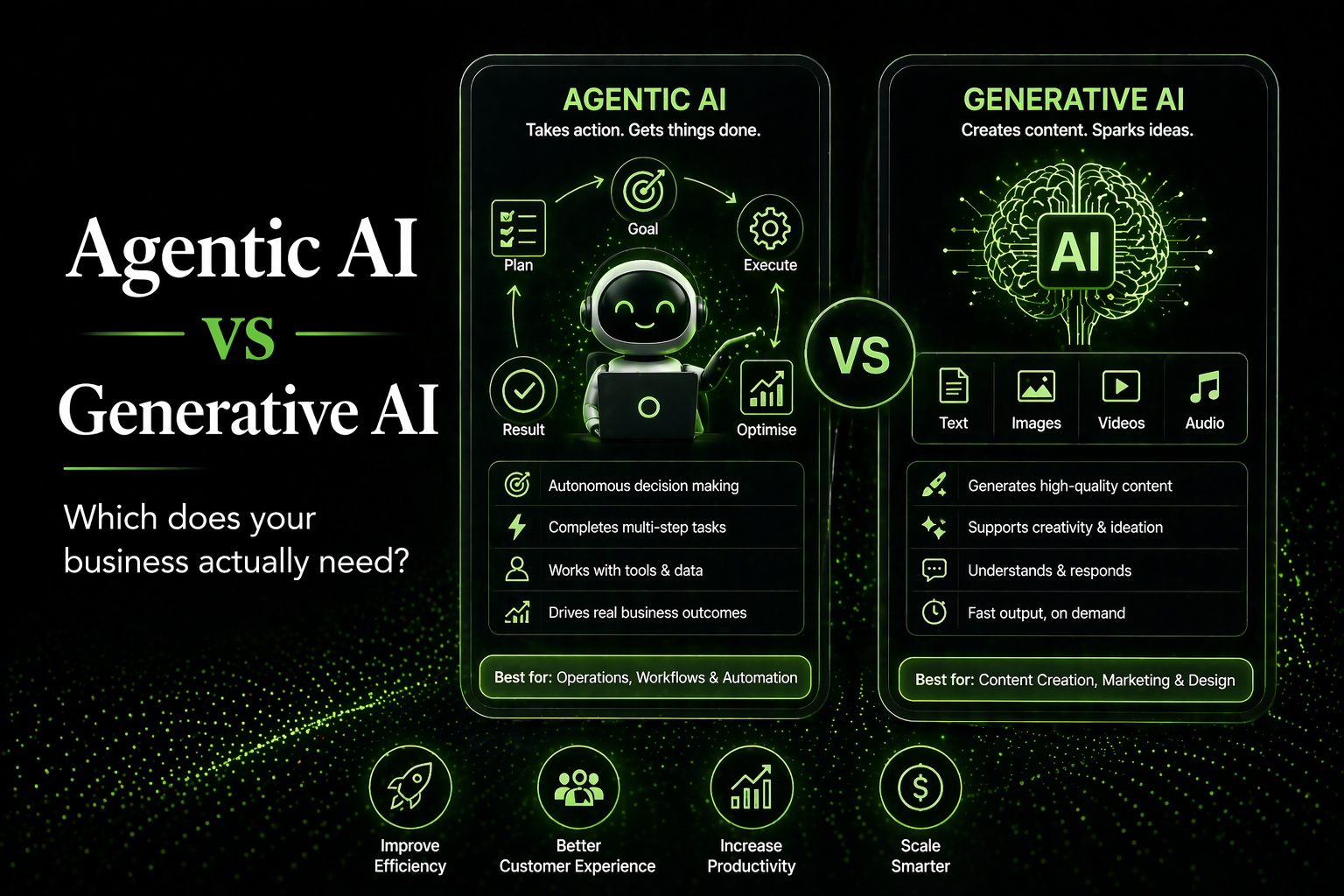
Generative AI is different because it creates. It is not limited to predicting from existing categories - it can write a blog post, produce a product image, draft a legal document, or generate a customer response. The shift from analytical AI to generative AI opens up entirely new applications for businesses.
The two types are not competing - they work well together. Many modern business AI systems combine analytical AI for decision-making with generative AI for content and communication.
What Can Generative AI Actually Create?
The output types that generative AI can produce have expanded significantly over the past two years. Today, businesses are using generative AI for:
- Written content - blog posts, marketing copy, product descriptions, emails and reports
- Images and visuals - product photos, social media graphics, brand assets and illustrations
- Audio and voice - voiceovers, podcasts, audio descriptions and call scripts
- Video - short-form content, explainer videos and automated video production
- Code - writing, reviewing and debugging software code
- Conversational responses - customer support chatbots, internal knowledge assistants and sales bots
The range of applications keeps growing. What matters for your business is finding the specific tasks where generative AI can save time, reduce cost or improve quality - and then building a system that does those tasks reliably.
How Is Generative AI Being Used by Australian Businesses Right Now?
Australian businesses across many industries are already using generative AI in practical, results-driven ways. Some of the most common applications include automating the production of marketing content at scale, building customer-facing chatbots that handle enquiries around the clock, generating product descriptions for large ecommerce catalogues, and creating internal knowledge assistants that help staff access company information quickly.
The businesses seeing the best results are not simply using public tools like ChatGPT. They are working with custom generative AI development services to build systems trained on their own data, integrated into their own workflows, and aligned to their specific brand and processes. This is what separates AI that genuinely improves efficiency from AI that just adds noise.
What Are the Limitations of Generative AI?
Generative AI is powerful, but it is not perfect. There are important limitations every business should understand before implementing it.
- Accuracy - generative AI can produce incorrect information, especially on specialised or recent topics. Human review is essential for high-stakes content
- Consistency - without custom training and proper prompting, outputs can vary significantly in quality and tone
- Data privacy - public AI tools may store or learn from your inputs, which creates risk for sensitive business data
- Context - AI systems do not truly understand your business. Without being trained on your specific data, outputs will be generic
- Bias - models can reflect biases present in their training data, which requires ongoing monitoring
These limitations are not reasons to avoid generative AI. They are reasons to implement it properly - with the right architecture, training, and oversight in place. When built correctly, the benefits far outweigh the risks.
Is Generative AI Right for Your Business?
If your business produces large volumes of content, handles repetitive customer communications, manages complex internal knowledge, or runs marketing campaigns that require constant creative output - generative AI is worth exploring seriously.
The key is to approach it strategically. Start by identifying the specific tasks where AI can add the most value. Then work with a specialist who understands both the technology and your business context. Generic public tools are a starting point, but they are not a long-term strategy.
Custom generative AI development services build systems specifically designed for your business - trained on your data, aligned to your brand, and integrated into your existing workflows. That is where the real business value begins.