Agentic AI vs Generative AI — What Is the Difference and Which Does Your Business Need?
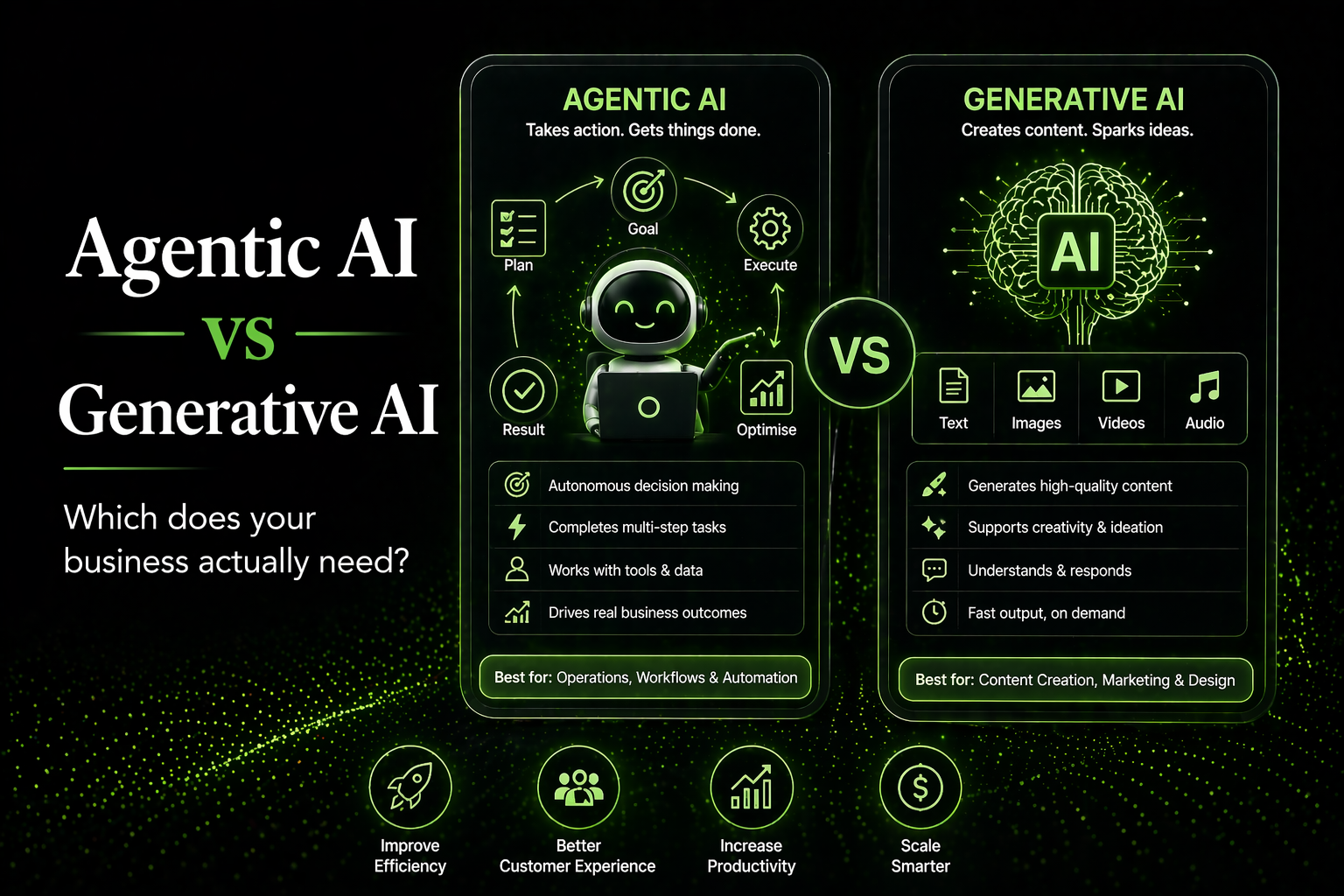
Two Types of AI — A Practical Distinction
If you have been reading about AI for business lately, you have probably come across both generative AI and agentic AI. They are related — agentic AI often uses generative AI as part of its toolset — but they are fundamentally different in what they do and how they operate. Understanding the distinction helps you make better decisions about which type of AI investment makes sense for your business right now.
This article explains both clearly, compares them honestly, and gives you a practical framework for deciding which approach fits your current goals. There is no right or wrong answer — the best choice depends entirely on what you are trying to achieve.
What Is Generative AI?
Generative AI is AI that creates content. You give it a prompt or instruction, and it produces an output — a piece of text, an image, a piece of code, a response to a customer question. The process is largely reactive. You ask, it responds. Each interaction is relatively self-contained.
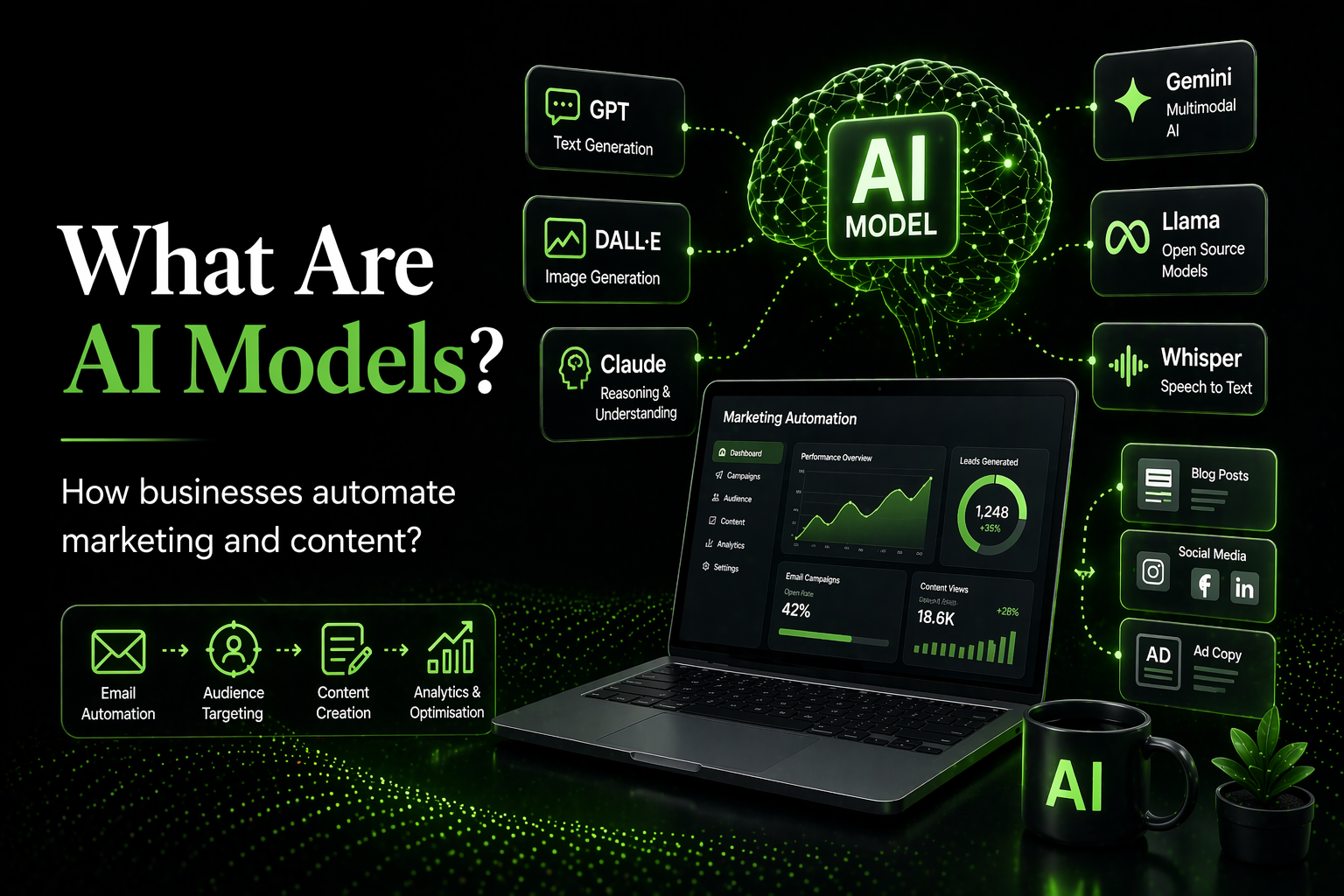
Generative AI systems include tools like ChatGPT, image generators, and custom AI models trained on your business data. They are excellent at producing high-quality content quickly, automating repetitive creative and communication tasks, and making the knowledge stored in your business data accessible through natural language.
What Is Agentic AI?
Agentic AI is AI that acts. Instead of simply responding to a prompt, an agentic AI system can take a series of actions to complete a goal. It can plan, make decisions, use tools, browse the web, write and execute code, send emails, update databases, and interact with other software systems — all with minimal human input at each step.
A simple example: you tell an agentic AI to research the top ten competitors in your market, summarise their pricing, and add the results to a spreadsheet. Rather than just generating a response, the agent actively browses websites, extracts data, analyses it, formats the output, and saves the file. It completes a multi-step task end to end.
How Agentic AI Uses Generative AI?
Most agentic AI systems use generative AI as their reasoning engine. The agent's ability to understand instructions, interpret information, and decide what to do next is powered by a large language model — which is a generative AI system. So the two are not in competition. Agentic AI is built on top of generative AI and extends it with the ability to take action.
The Core Difference Between Agentic AI and Generative AI
The clearest way to understand the difference is this: generative AI is a tool that produces outputs when you ask it to. Agentic AI is a system that pursues goals and takes actions to achieve them.
- Generative AI — responds to prompts, creates content, operates in single interactions
- Agentic AI — pursues goals, takes sequences of actions, operates across multiple tools and platforms
- Generative AI — you are in control of each step
- Agentic AI — you define the objective, the agent determines how to achieve it
- Generative AI — excellent for content, communication, and knowledge retrieval
- Agentic AI — excellent for research, automation, and multi-step business processes
Neither is inherently better. They solve different problems. For most businesses in Australia, generative AI is the more immediate and practical starting point — with agentic AI becoming relevant as AI maturity in the organisation grows.
When to Use Generative AI for Your Business
Generative AI is the right choice when your goal is to produce content, automate communication, or make your business knowledge more accessible. If you need to scale marketing content production, build a customer-facing chatbot, generate product descriptions at volume, or create an internal knowledge assistant — generative AI is your starting point.
It is also the right choice when you want clear control over every AI output before it reaches a customer or is published. Generative AI systems produce outputs that a human can review and approve before they go anywhere. This makes them appropriate for brand-sensitive applications where quality control is important.
When to Use Agentic AI for Your Business?
Agentic AI makes sense when your goal is to automate multi-step processes that currently require human decision-making at each stage. Research workflows, data gathering, reporting, system updates, and complex customer journey orchestration are all areas where agentic AI can add significant value.
It is important to note that agentic AI systems require careful design and oversight. Because they take actions — sometimes in live systems with real consequences — they need well-defined boundaries, clear success criteria, and robust testing before deployment. Agentic AI is more powerful than generative AI, and with that power comes greater complexity.
Which AI Approach Should Australian Businesses Prioritise in 2026?
For most Australian businesses that are early in their AI journey, generative AI development services represent the best starting point. The value is clear, the implementation is more straightforward, and the results can be measured quickly. A custom generative AI solution — a chatbot, a content engine, or a knowledge assistant — can be built, tested and deployed in weeks, not months.
Agentic AI is the logical next step once your business has established a solid generative AI foundation and built internal confidence in AI systems. Starting with agentic AI before that foundation is in place often leads to complex projects that are difficult to manage and slow to deliver results.
The two approaches are complementary. Build your generative AI capability first, demonstrate value, and then extend into agentic AI where specific business processes justify the investment. That sequencing produces better outcomes than trying to tackle both simultaneously.