What Is PHP Web Development and Why Do Australian Businesses Still Use It in 2026?
What Is PHP? Simple Explanation
PHP is a programming language used to build websites and web applications. It runs on the server side, which means it processes logic and data before the page is sent to your browser. When you fill out a form, log into an account, or submit an order on a website, there is a good chance PHP is handling that request behind the scenes.
The name originally stood for Personal Home Page, but today it stands for PHP: Hypertext Preprocessor. That technical history does not matter much for business owners. What matters is that PHP is one of the most widely used server-side languages in the world, it has a massive developer community, and it powers some of the most successful platforms on the internet.
If you have ever used WordPress, WooCommerce, Magento or Laravel, you have used software built on PHP. These platforms are trusted by millions of businesses globally. They exist because PHP is stable, flexible, well-supported and cost-effective to build on.
Why PHP Is Still Relevant in 2026?
PHP has been declared dead many times over the past decade. It has not died. In fact, PHP development in Australia and globally remains extremely active. The language itself has evolved significantly. Modern PHP - versions 8.0 and above - is faster, more secure, and more capable than the PHP most people picture when they hear criticisms of it.
Performance improvements in recent PHP versions have been dramatic. PHP 8.x is substantially faster than PHP 5.x, which was the version responsible for most of PHP's historical performance reputation. On modern server configurations, PHP-based applications are competitive with Node.js and other alternatives for most standard web use cases.
The developer ecosystem is another key reason for PHP's longevity. There are more PHP developers available in Australia and globally than for most other server-side languages. This matters practically - it affects hiring cost, contractor availability, and the ease of finding someone to maintain or extend your project in the future.
Major Platforms and Frameworks Built on PHP
The reach of PHP becomes clear when you look at the platforms it powers. These are not legacy or obscure systems - they are actively developed, widely trusted, and in use by some of the largest organisations in the world.
- WordPress - the world's most popular CMS, powering 40.8% of all websites (W3Techs).
- WooCommerce - the most widely used ecommerce platform for small to mid-sized businesses.
- Magento (Adobe Commerce) - a leading enterprise ecommerce platform.
- Laravel - one of the most respected and widely used PHP frameworks for custom web application development.
- Symfony - a high-performance PHP framework used in enterprise and government applications.
- Drupal - a powerful CMS used by universities, media organisations and government agencies.
Laravel in particular has changed the perception of PHP among developers. It is a modern, well-designed framework that makes PHP web application development clean, testable and scalable. Many PHP developers who previously considered moving to other stacks have stayed with PHP specifically because of Laravel.
When PHP Web Development Is the Right Choice?
PHP is the right choice for most standard website and web application projects where you want access to a large talent pool, mature frameworks, and a well-understood technology stack. It is especially well-suited for:
- CMS-based websites - WordPress and other PHP-powered platforms are the most practical and cost-effective solution for most content-driven sites
- Ecommerce platforms - WooCommerce and Magento offer mature, feature-rich ecommerce solutions built on PHP
- Custom web applications - Laravel and Symfony provide a solid, scalable foundation for bespoke web apps
- Business systems - internal tools, portals, booking systems and management platforms built on PHP are easy to maintain and extend
- Projects where ongoing maintenance is a priority - the large PHP developer community in Australia means finding support is easy
If you are working with a web development company and they propose PHP as part of your solution, it is not a red flag. For most standard projects, it is a sensible and practical choice.
When PHP Might Not Be the Best Fit?
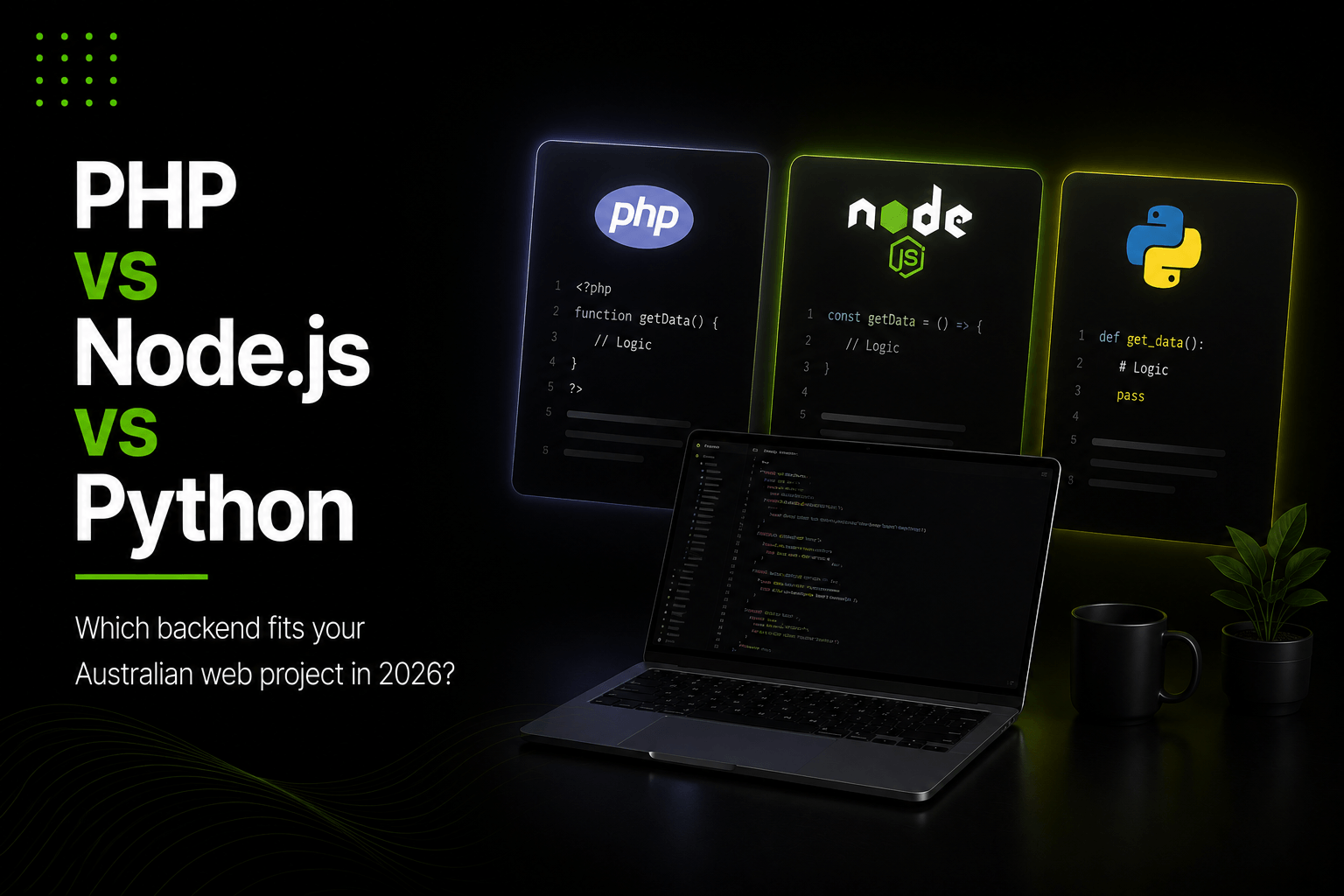
PHP is not the right tool for every job. There are scenarios where other languages are better suited. Real-time applications - like live chat systems, collaborative tools or streaming platforms - often benefit from Node.js, which handles many simultaneous connections more efficiently. Machine learning and data science applications are better served by Python, which has a far richer ecosystem for those specific use cases.
Very high-performance, low-latency systems that require microsecond response times may also be better served by languages like Go or Rust. These are specialist cases, not typical business web projects. For the vast majority of Australian business websites and web applications, PHP is entirely adequate.
Performance: PHP vs Other Languages in 2026
The honest comparison is that for standard web application workloads, the performance difference between modern PHP, Node.js, and Python is not meaningful in practice. The bottleneck in most web applications is the database query or the network, not the language itself. A well-written PHP application will perform comparably to a well-written Node.js application for typical business use cases.
Where Node.js has a genuine advantage is in handling very high levels of concurrent connections - useful for real-time features like live updates or chat. For everything else, PHP performs well and the developer productivity advantage of working in a mature, well-documented framework often makes PHP the more practical choice.
What to Look For in a PHP Developer in Australia?
When hiring a PHP developer or choosing a PHP development services company, there are a few key things to look for beyond just knowing the language.
- Framework experience - a good PHP developer should be proficient in Laravel, Symfony, or both
- Security awareness - PHP has historically had security issues that stem from poor coding practices. A strong developer will follow current best practices for input validation, authentication and data handling
- Testing capability - modern PHP development includes unit testing and automated testing as standard, not an afterthought
- Database experience - most PHP applications rely heavily on MySQL or PostgreSQL; database design and query optimisation matter
- Version currency - ensure your developer is working with PHP 8.x, not legacy versions
The best PHP web application development partners in Australia treat PHP as a professional, modern development environment - not a fallback option. If you are evaluating a development partner, ask them which PHP version and framework they use as a default, and ask to see examples of well-structured code from past projects. Their answers will quickly tell you where they sit on the skill spectrum.