Generative AI Chatbot for Business — How It Works and What It Can Do for Your Team?
What Is a Generative AI Chatbot?
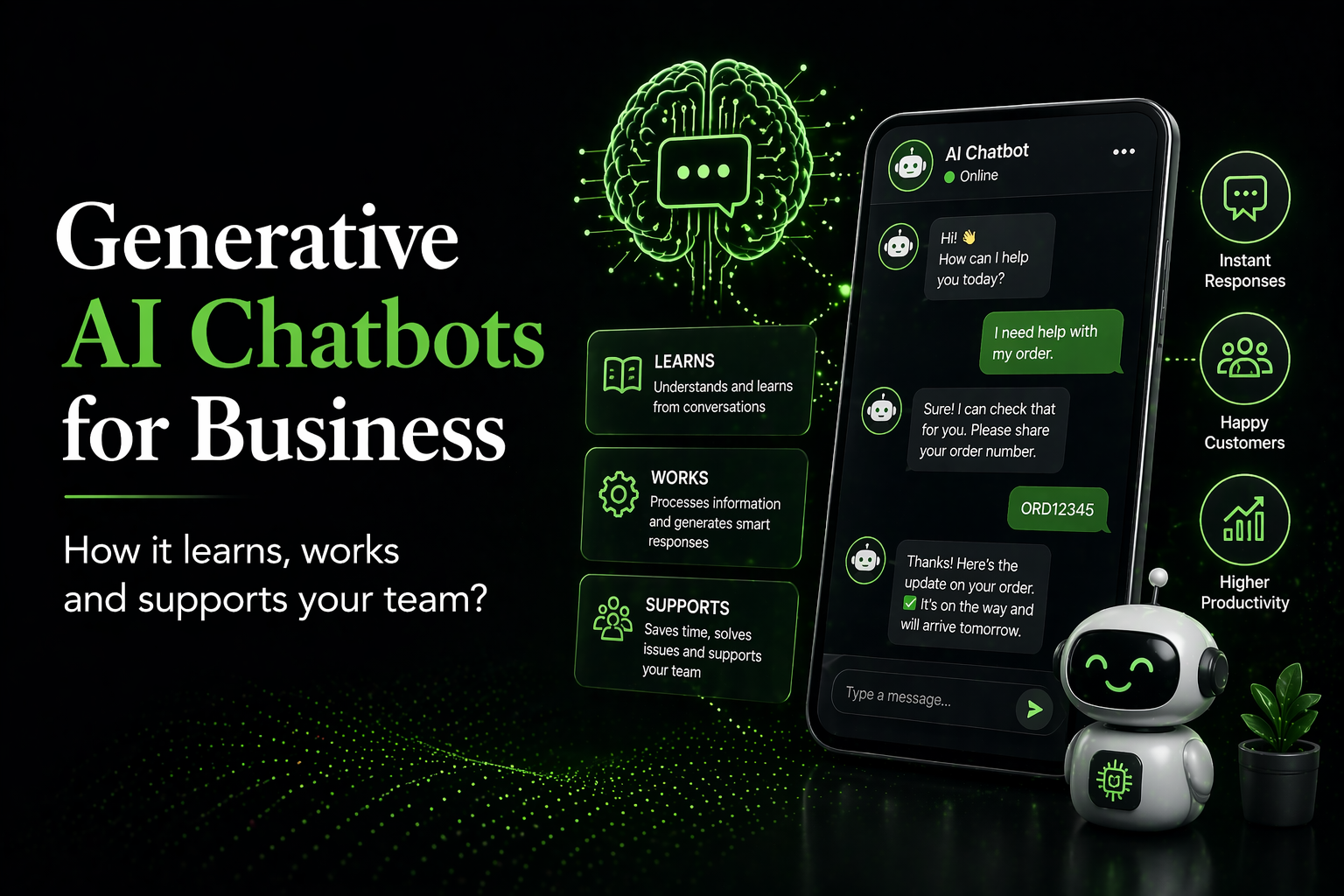
A generative AI chatbot is a conversational AI system that can understand questions, interpret context, and produce accurate, helpful responses in natural language. Unlike a basic chatbot that follows a script or a decision tree, a generative AI chatbot generates its answers dynamically — drawing on a knowledge base, your internal data, or a custom-trained AI model.
The result is a system that can handle a much wider range of questions than any traditional chatbot, respond in a way that reflects your brand voice, and improve over time as it processes more interactions.
For businesses that receive high volumes of customer enquiries, manage complex internal knowledge, or want to provide consistent support outside business hours, a generative AI chatbot is one of the most practical and impactful AI tools available.
How Is a Generative AI Chatbot Different From a Regular Chatbot?
Traditional chatbots work by following rules. You programme a set of questions and answers, and the bot matches user input to the nearest pre-written response. If a user asks something outside the programmed list, the bot fails. The experience often feels robotic and frustrating — because it is.
A generative AI chatbot works differently at a fundamental level. It understands language rather than just matching patterns. It can handle questions it has never seen before, follow the thread of a multi-turn conversation, and generate responses that feel genuinely helpful rather than scripted. When trained on your business data, it can accurately represent your products, policies, pricing and processes — without requiring you to manually programme every possible scenario.
The Role of Training Data in AI Chatbot Quality
The quality of a generative AI chatbot depends heavily on what it is trained on. A chatbot built on a generic foundation model will give generic answers. A chatbot trained on your specific business content — your website, your product documentation, your support history, your internal knowledge base — will give accurate, relevant answers that reflect your actual business.
This is why custom training matters. When a generative AI chatbot is built properly, it knows your business as well as your best support team member. It does not guess. It does not make things up. It answers based on the actual content it has been trained on, which makes it reliable enough to trust with real customer interactions.
What Can a Generative AI Chatbot Handle for Your Business?
The range of tasks a well-built generative AI chatbot can handle is broader than most businesses expect. Here are the most common and valuable applications.
- Customer support — answering product and service questions accurately, at any hour, without wait times
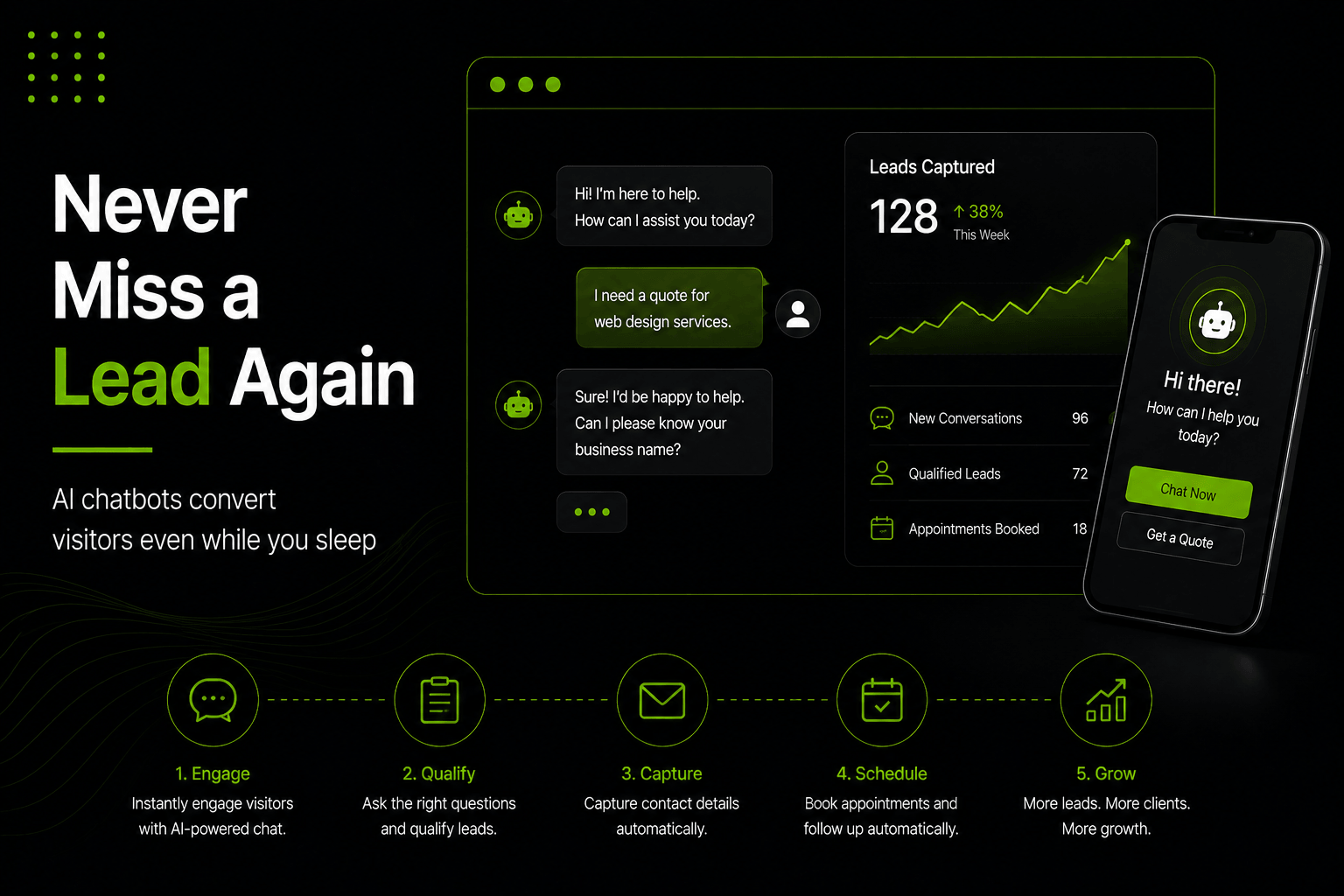
- Lead qualification — asking the right discovery questions and capturing prospect information before passing to your sales team
- Internal knowledge access — helping staff find policies, procedures, product specs or historical information instantly
- Appointment and booking workflows — guiding customers through scheduling processes without human intervention
- Order tracking and account enquiries — giving customers real-time updates on their orders or accounts
- Onboarding assistance — walking new customers or employees through processes step by step
The key across all of these applications is that the chatbot handles volume and repetition, freeing your human team to focus on complex, high-value interactions. It does not replace people — it removes the tasks that did not need people in the first place.
Generative AI Chatbot vs Rule-Based Chatbot — The Key Differences
The gap between a rule-based chatbot and a generative AI chatbot is significant. Here is a direct comparison across the areas that matter most.
- Flexibility — rule-based bots handle only pre-programmed scenarios. Generative AI handles anything within its training
- Accuracy — rule-based bots fail on unexpected questions. Generative AI understands intent and responds appropriately
- Maintenance — rule-based bots need constant manual updates. Generative AI learns and can be retrained as your business evolves
- Tone — rule-based bots speak in fixed scripts. Generative AI reflects your actual brand voice
- Complexity — rule-based bots struggle with multi-part questions. Generative AI maintains context across a full conversation
The decision to upgrade from a rule-based system to a generative AI chatbot is not just about technology — it is about the quality of experience you want to deliver to your customers and team.
Industries Benefiting Most From AI Chatbots in Australia
Generative AI chatbots are delivering real results across a range of Australian industries. Healthcare providers are using them to handle patient enquiries, appointment scheduling and general information requests, freeing clinical staff for patient care. Professional services firms in legal and finance are using them to provide initial information and qualify enquiries before they reach a consultant. Ecommerce businesses are using them to handle product questions, returns processes and post-purchase support at scale.
SaaS companies use them for onboarding and in-product support. Real estate agencies use them to handle property enquiries outside business hours. Any business that handles a significant volume of repetitive customer communication can benefit from a well-built generative AI chatbot.
How to Implement a Generative AI Chatbot Without Disrupting Your Team?
Implementing a generative AI chatbot does not need to be disruptive. The most successful deployments follow a clear process: start with a defined use case, build on a solid data foundation, test thoroughly before launch, and roll out gradually. Beginning with a single function — customer support FAQs, for example — allows you to demonstrate value quickly and build internal confidence before expanding.
The implementation process should include a discovery phase where your current workflows and knowledge base are documented, a build phase where the chatbot is trained and integrated, and a testing phase where real queries are used to refine accuracy and tone. Done properly, your team should see the chatbot as a useful colleague, not a replacement.
Building a Chatbot That Actually Works
The most important factor in a successful generative AI chatbot is not the technology — it is the quality of the training data and the clarity of the brief. A chatbot that has been given clean, comprehensive, well-structured business data will outperform a more sophisticated system built on poor inputs every time.
If you are considering a generative AI chatbot for your business, start by documenting what your best support team members know. That knowledge base becomes the foundation for a chatbot that genuinely helps your customers and your team — and delivers measurable results from day one.