Social Media Content Creation: How Australian Brands Build Content That Stops the Scroll?
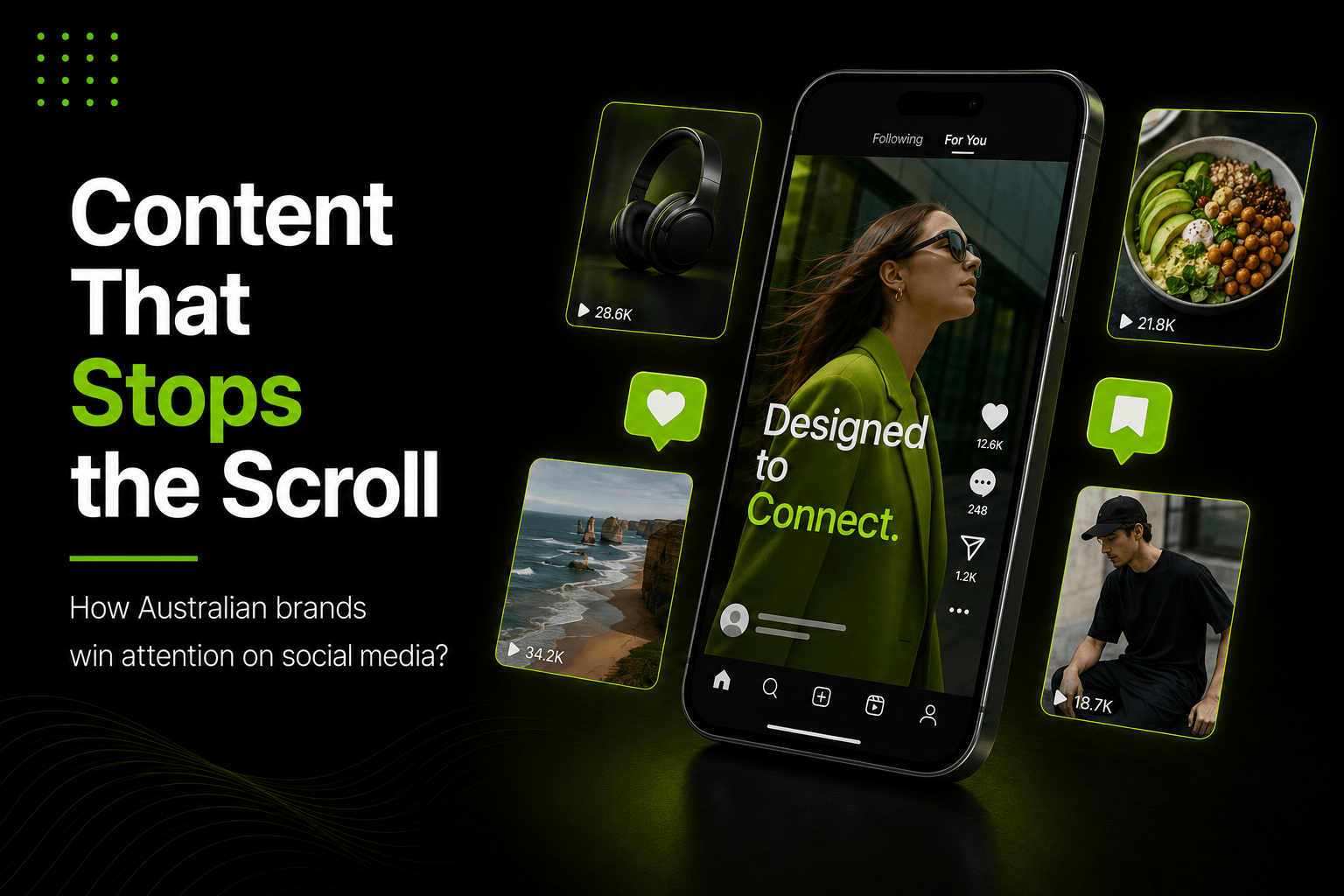
The average Australian spends over 1 hour and 45 minutes on social media every day. In that time, they scroll through hundreds of posts, stories, reels, and ads. They stop for about 2 seconds on each one — and that 2 seconds is the only window your brand has.
Most social media content fails that test immediately. It looks like every other post in the feed — a generic stock photo, a logo, a caption that starts with 'We are excited to announce'. The user scrolls past without a second thought. The brand wonders why social media is not working.
The brands that win on social media — that build real audiences, generate genuine engagement, and turn followers into customers — do something different. This guide shows you what that looks like, and how to apply it to your Australian business.
Why Most Social Media Content Gets Ignored?
Before you can create content that works, you need to understand why most content fails. There are three primary reasons.
It Leads With the Brand, Not the Audience
The most common mistake in social media content creation is making it about your business instead of your audience. 'We launched a new service' is about you. 'Here is how to solve the problem you have been struggling with' is about them. Social media is a conversation, not a broadcast. Content that starts from the audience's perspective — their problems, desires, questions, and aspirations — gets engagement. Content that leads with brand announcements gets ignored.
It Looks Like Everything Else
Most brand feeds look the same. Stock photography. Brand-coloured graphic templates. Captions that sound like a press release. When every brand in a category uses the same design templates and the same tone of voice, there is no visual or emotional hook that makes a user stop. Distinctiveness — in visual style, tone, format, or perspective — is what makes content earn attention.
It Does Not Have a Hook
A hook is the first thing someone sees or reads — the element that creates enough curiosity, emotion, or recognition to make them pause. Without a hook, even well-produced content disappears into the feed. Every piece of content you create needs a reason for someone to stop. Not a reason to buy. Just a reason to pause for 2 seconds and see what it is.
The Elements of Content That Stops the Scroll
1. A Thumb-Stopping Visual
For static images, the visual must earn attention instantly. High-contrast images, bold typography, unexpected subject matter, or genuine human faces consistently outperform stock photography and generic brand graphics. For video, the first frame and first movement matter as much as the hook text. Test content using your own photography and video against stock alternatives — most Australian brands find authentic imagery significantly outperforms stock.
2. A Hook That Creates Curiosity or Recognition
The first line of your caption, the first words of your video, the headline on your graphic — this is your hook. The best hooks do one of four things: they promise a specific, valuable outcome, they challenge a common belief, they ask a question the audience is already wondering, or they create pattern interruption by saying something unexpected. 'Why your Instagram strategy is backwards' hooks more effectively than 'Our Instagram tips for 2026'.
3. A Clear Point of View
Generic content takes no position. Content with a clear point of view — an opinion, a recommendation, a stance on how things should be done — is shareable because people agree or disagree. Australian audiences respond well to directness and practical honesty. You do not need to be controversial. You need to have a perspective and express it clearly.
4. Value Before the Click
The most-saved and most-shared content on Instagram and LinkedIn in Australia is educational content that delivers value before asking for anything. A carousel post that teaches something useful in 7 slides. A Reel that answers a question in 60 seconds. A LinkedIn post that shares a genuine insight from a project or client experience. Giving value first builds the trust that eventually converts followers into customers.
Content Formats That Work Best for Australian Brands in 2026

Content Formats That Work Best for Australian Brands in 2026
The Content Creation Process for Australian Brands
Phase 1: Idea Generation
The best content ideas come from your audience — not from a brainstorm. Mine these sources consistently: questions your customers ask in sales calls and emails, common objections you hear before someone buys, topics your competitors are covering that you have a different perspective on, comment sections and DMs from your existing audience, and trending topics in your industry that you can add genuine expertise to.
Phase 2: Content Planning
Once you have ideas, plan them against your content pillars and your publishing calendar. Assign formats to each idea — this topic works as a Reel, this one works better as a carousel. Batch similar content types together so you can produce multiple pieces in one session. Most Australian businesses find that producing content in weekly or fortnightly batches is far more efficient than creating day by day.
Phase 3: Content Production
For video: shoot in portrait orientation (9:16) for Reels and Stories, aim for 15 to 60 seconds for Reels, and always shoot with audio but design for mute with captions. For static images: use your brand's colour palette and typography consistently, prioritise real photography over stock, and test both single images and graphic overlays on photography. For captions: write the first line as a standalone hook, use short paragraphs, and always end with a clear call to action even if it is just 'Save this for later'.
Phase 4: Publishing and Testing
Publish at the times your specific audience is most active — check your Instagram or Facebook Insights for your peak engagement windows. In general, Australian audiences on Instagram are most active between 7 to 9am and 6 to 9pm on weekdays. Test different formats, hooks, and topics systematically — not randomly. Track which content generates saves, shares, and profile visits, as these are the strongest signals of content that is resonating.
Building a Brand Voice That Feels Human
Brand voice is how your business sounds across all content. Australian audiences respond particularly well to brands that are direct, honest, occasionally self-deprecating, and practical. They are quick to disengage from content that sounds corporate, overly polished, or inauthentic.
Define three to five words that describe your brand's tone of voice and test every piece of content against them. Casual but credible. Direct but warm. Expert but accessible. These guardrails help every person creating content for your brand produce something that sounds consistently like your brand — regardless of who is writing it.
💡 The brands with the fastest-growing social media audiences in Australia in 2026 are not the ones with the biggest budgets. They are the ones with the most consistent brand voice, the clearest point of view, and the most genuine connection with their specific audience.
Frequently Asked Questions
Q. How many social media posts should Australian businesses publish per week?
For most Australian businesses, 3 to 5 posts per week on primary platforms (Instagram, Facebook, LinkedIn) with daily story activity produces strong results without overwhelming the content team. Quality and consistency matter more than volume. Two genuinely valuable posts per week will outperform seven mediocre ones. Start with a cadence you can maintain consistently for 90 days before increasing volume.
Q. Should Australian businesses use hashtags in 2026?
Hashtags have significantly reduced organic reach impact on Instagram and Facebook compared to 2020 to 2022. In 2026, most social media experts recommend 3 to 5 highly relevant hashtags rather than 30 generic ones — or no hashtags at all on Facebook. On Instagram, the algorithm now primarily distributes content based on engagement signals rather than hashtag categories. Focus on creative quality over hashtag strategy.
Q. Is it better to create video or static image content?
Video consistently outperforms static images for organic reach on Instagram, Facebook, and TikTok in 2026. Short-form video — particularly Reels under 60 seconds — receives the widest algorithmic distribution of any content format on Meta's platforms. However, carousel posts generate the highest save rates and are excellent for educational content. A mix of Reels for reach and carousels for engagement depth is the most effective combination for most Australian brands.
Need help creating social media content that stops the scroll and drives results for your Australian business? Talk to Ziff Digital's social media content team.