Social Media Marketing vs SEO: Which Should Australian Businesses Invest In First?
You have a limited marketing budget. You know you need to be visible online. And you have two people in your ear - one saying 'you need to be on Instagram', the other saying 'you need to rank on Google'. Both are right. Both cannot be your first priority. So which comes first?
This is one of the most common strategic questions Australian business owners face in 2026 - and most of the answers online are vague, self-serving, or both. This guide gives you a direct, honest answer based on how each channel actually works, who it works for, and which one your specific business should prioritise.
The Honest Truth: They Work Completely Differently
Before comparing them, you need to understand that SEO and social media marketing are not competing versions of the same thing. They reach people at completely different stages of the buying journey, in completely different ways.

Social Media Marketing vs SEO
How SEO Actually Creates Business Value?
Search engine optimisation improves your website's visibility in Google when Australians search for what you offer. When someone types 'commercial electrician Sydney' or 'custom app development company Australia' into Google, SEO determines whether your business appears on page one - where the clicks are - or page four, where nobody goes.
The power of SEO is its compounding nature. A blog post or service page that ranks in Google today will continue driving traffic tomorrow, next month, and next year - often without any additional investment. The HubSpot State of Marketing 2026 report confirms that website, blog, and SEO remains the number one ROI-generating channel for marketers overall. SEO is not just a traffic strategy - it is an asset-building strategy.
The trade-off is time. SEO takes 3 to 12 months to produce meaningful results for most Australian businesses. If you need leads this week, SEO is not going to save you. If you are building a sustainable, scalable source of organic leads over the next 12 to 36 months, SEO is often the highest-returning channel you can invest in.
How Social Media Marketing Actually Creates Business Value?
Social media marketing builds your brand's presence and audience on platforms like Instagram, Facebook, LinkedIn, and TikTok. Organic social media builds community, brand awareness, and trust over time. Paid social advertising - Facebook and Instagram ads - can generate leads and sales much faster, with results visible within days of launching a campaign.
Social media's strength is its ability to reach people who are not actively searching for you. It puts your brand in front of people who match your ideal customer profile, even when they are not in buying mode. This top-of-funnel brand building is genuinely valuable - but it requires consistency, quality, and usually a meaningful ad budget to scale.
The challenge with social media is that it requires constant feeding. Stop posting and your visibility drops. Stop running ads and your leads stop. Unlike an SEO-ranked page that keeps working without you, social media results are directly tied to ongoing effort and spending.
Which Delivers Better ROI?
The honest answer is that it depends on your business model, industry, and timeline. But here is what the data shows for Australian businesses.
SEO Delivers Better Long-Term ROI for Most Businesses
Once an SEO campaign builds rankings, the cost per lead tends to fall significantly over time. You are no longer paying to acquire each lead - the infrastructure works for you. Businesses in professional services, B2B, healthcare, and trade services consistently see strong long-term ROI from SEO because their customers actively search Google when they need a solution.
Paid Social Media Delivers Faster Short-Term Results
If you need leads now - for a product launch, a seasonal campaign, or to fund other marketing investment - paid social advertising on Facebook and Instagram can deliver fast, measurable results. Targeting precision on Meta's platforms is genuinely impressive, and the ability to reach specific demographics, interests, and behaviours makes paid social a powerful lead generation tool in the right context.
Organic Social Media Builds Brand, Not Always Revenue
Organic social media - posting content without paying to boost it - rarely generates direct revenue by itself for most Australian service businesses. Its value is in brand awareness, community building, trust, and supporting other marketing channels. It is an important part of the marketing mix but rarely the primary revenue driver on its own.
According to HubSpot's State of Marketing Report 2026, website, blog and SEO content remains the #1 ROI-generating channel for marketers, followed by paid social media at 26%. Organic-only social media is not in the top five.
The Right Choice Based on Your Business Situation
Here is a practical decision framework for Australian businesses.
Invest in SEO First If:
- Your customers actively search Google for the problem you solve ('accountant Melbourne', 'custom app development company', 'physio near me').
- You are in professional services, B2B, trades, healthcare, or legal - categories where trust and research drive purchases.
- You have a 6–12 month horizon for results and can invest consistently.
- You want a long-term asset that generates leads without ongoing ad spend.
- You are publishing regular blog content or willing to start - content is the fuel that drives SEO.
Invest in Social Media First If:
- Your product or service is highly visual - fashion, food, fitness, interior design, beauty, travel.
- Your customers discover brands through Instagram, TikTok, or Facebook before they search Google.
- You need leads quickly - a paid social campaign can generate enquiries within weeks.
- You are launching a new product or entering a new market where brand awareness is the priority.
- Your target audience is on LinkedIn and you are selling B2B services where professional credibility matters.
Do Both If:
- You have a budget of $3,000 per month or more that you can split across channels.
- You are an e-commerce business where both Google Shopping (SEO-adjacent) and Instagram/TikTok drive sales.
- You want to compound results - content you create for SEO can be repurposed for social, and your social audience amplifies your SEO content.
- You understand that the two channels serve different stages of the customer journey and measure them accordingly.
The Real Answer: They Are Better Together
The businesses winning at digital marketing in Australia in 2026 are not choosing between SEO and social media - they are using both in a coordinated way. A blog post optimised for SEO gets shared on social media and drives traffic.
A social media post builds enough interest that someone searches Google for more information and finds your SEO-optimised website. Paid social ads retarget people who found you through organic search.
The channels reinforce each other. Businesses that treat them as separate decisions - and most do - are leaving compounding value on the table.
The practical reality for most Australian businesses with limited budgets is to start with the channel that matches your customer's primary discovery behaviour, build that foundation, and then layer in the second channel as your budget allows.
A Note on GEO - The Third Channel Australian Businesses Need to Know About
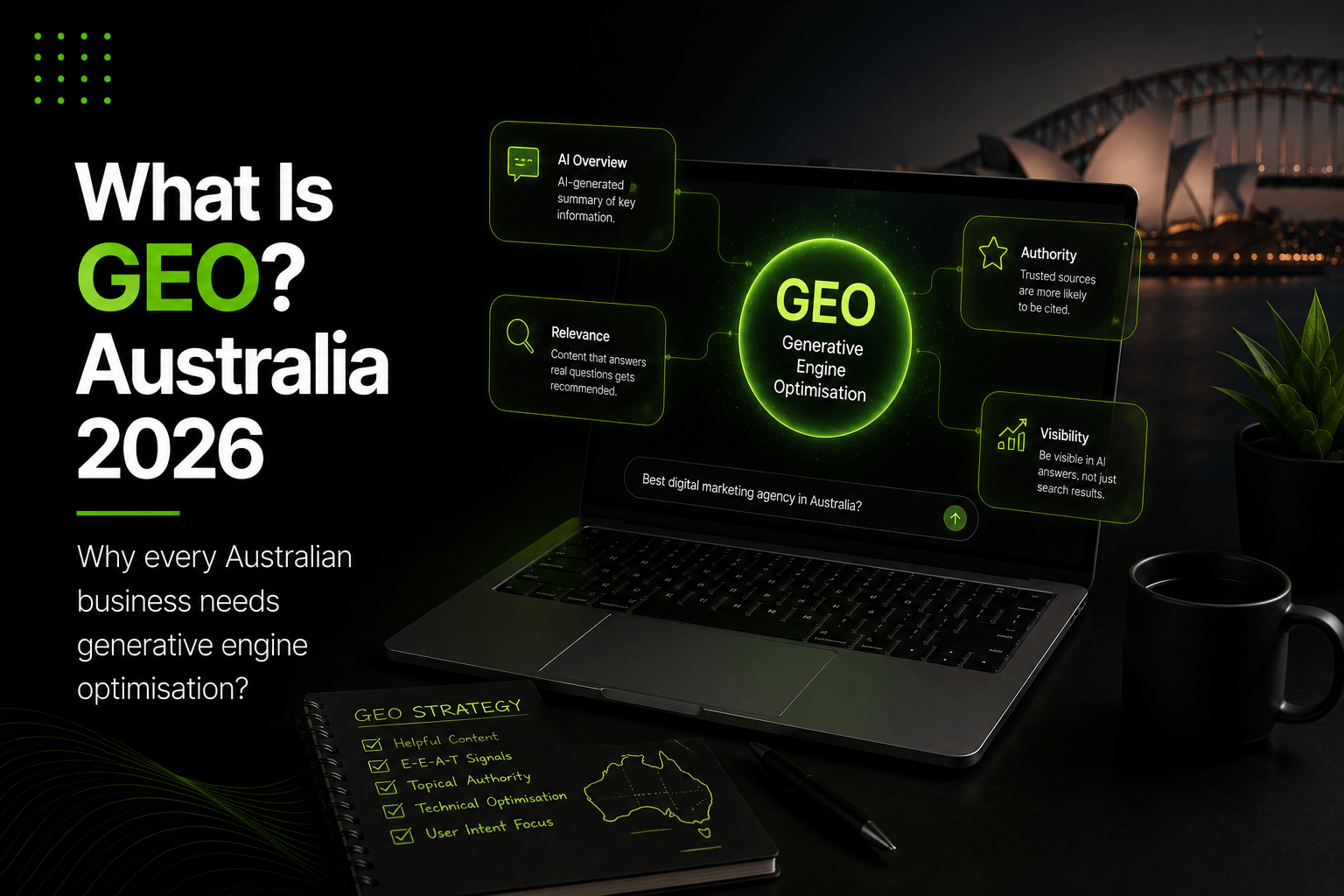
In 2026, there is a third channel gaining real importance alongside SEO and social: Generative Engine Optimisation (GEO). As Google's AI Overviews, ChatGPT, and other AI tools answer more search queries directly - before the user even visits a website - appearing in those AI-generated answers has become a new source of visibility and trust.
GEO works differently from both SEO and social media. It focuses on creating authoritative, structured content that AI search engines cite and recommend. For Australian professional service businesses, this is an emerging opportunity worth tracking in 2026 and investing in alongside traditional SEO.
Frequently Asked Questions
Q 1. Is SEO or social media marketing more cost-effective for Australian small businesses?
For most Australian small businesses, SEO tends to be more cost-effective over a 12 to 24 month horizon because of its compounding nature. A well-ranked website keeps generating leads without proportional cost increases. Social media requires continuous spending to maintain results. That said, for businesses that need leads quickly or operate in highly visual categories, paid social media can deliver faster ROI in the short term.
Q 2. How long does SEO take to show results in Australia?
Most Australian businesses see meaningful SEO results - improved rankings and increased organic traffic - within 4 to 9 months of consistent investment. Competitive industries like legal services, finance, and healthcare take longer, typically 9 to 18 months. Less competitive niches and local service businesses can see results faster. SEO is a long-term investment; businesses that expect results in 30 days will be disappointed.
Q 3. Can social media marketing help my SEO?
Social media does not directly improve your Google rankings - social signals are not a confirmed ranking factor. However, social media can drive referral traffic to your website, increase brand search volume, and amplify your content to attract backlinks - all of which support SEO indirectly. The strongest connection is using social media to distribute your SEO content to a wider audience.
Q 4. What budget should an Australian SME spend on SEO vs social media?
A common starting approach for Australian SMEs with a combined digital marketing budget of $3,000 to $5,000 per month is to allocate 50 to 60 percent to SEO and 40 to 50 percent to social media marketing. The exact split depends on where your customers are most likely to be in their buying journey. A B2B services business might put 70 percent into SEO and LinkedIn. A consumer product brand might reverse that split in favour of Instagram and TikTok.
Q 5. Does every Australian business need both SEO and social media?
Not necessarily - but most businesses benefit from both in some form. A pure B2B software company might get 90 percent of its leads from SEO and LinkedIn while barely using Instagram. A local café might find that Instagram and Google Business Profile together are sufficient, with formal SEO investment lower priority. The channels you invest in should match where your specific customers actually make their buying decisions.
Want a clear strategy for how SEO and social media marketing should work together for your Australian business? Talk to Ziff Digital - we build integrated digital marketing strategies that compound results across channels.